THE COMEBACK NOBODY THOUGHT TIGER WOODS COULD MAKE
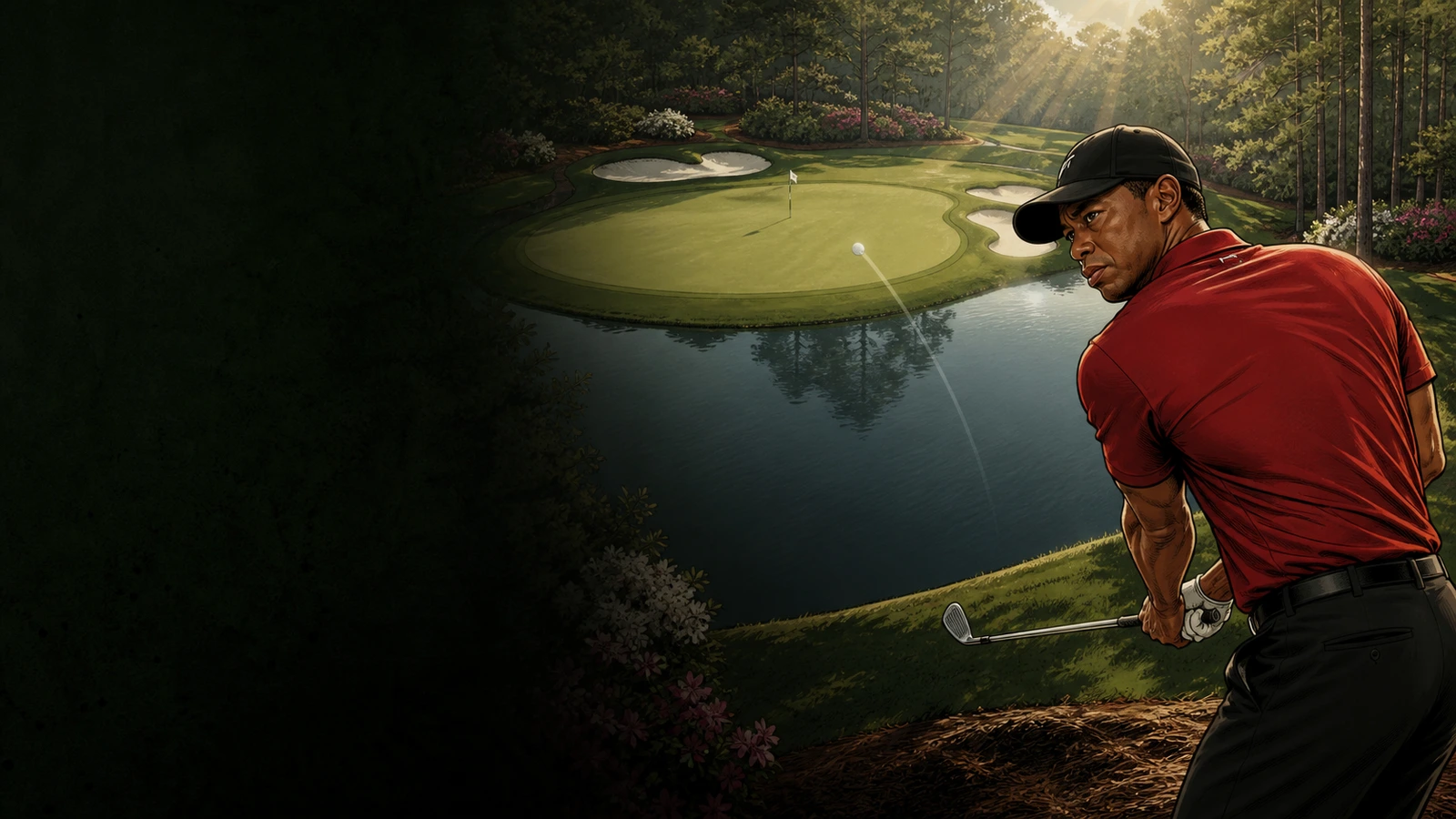
Three leading players attacked the flag at Augusta National's twelfth hole. Their balls found the water.
Tiger Woods aimed away from the flag.
For most of his career, Woods had been defined by the spectacular shot other players could not imagine. On 14 April 2019, the most important shot of his comeback was deliberately ordinary. He chose the safe part of the green, made par and watched a tournament that had seemed to belong to someone else move back towards him.
Woods had not won a major for almost eleven years. He had undergone four back operations. His world ranking had fallen outside the top one thousand. He began the final round two shots behind and had never won a major from behind after fifty-four holes.
So the question at the twelfth was larger than one shot. Could the most dominant golfer of his generation win differently—through restraint, patience and the experience of everything that had almost ended his career?
Woods's first Masters victory in 1997 had changed golf. He was twenty-one and won by twelve shots. Over the next decade, he accumulated majors at a pace that made historical records seem temporary. By the end of 2008, he had fourteen. His victory at the U.S. Open that year came despite a serious leg injury and required ninety-one holes. He was thirty-two. Nicklaus's eighteen looked within reach.
Then the clean upward line ended. Woods's personal life became public crisis. His form and health fractured. Back pain became the central problem of his playing career. Operations were followed by attempted returns, withdrawals and long absences. The body that had produced such speed could no longer be assumed to tolerate a practice session, much less four tournament rounds.
In 2017, after spinal fusion surgery, the objective was basic: live with less pain, move, and perhaps play golf with his children. Competitive success belonged to a later conversation.
The recovery did not move directly from surgery to Augusta. Woods returned during 2018 and slowly demonstrated that he could withstand tournament golf. He contended at the Open Championship. He challenged at the PGA Championship. In September, he won the Tour Championship, his first PGA Tour victory in more than five years. The gallery followed him up the eighteenth fairway in Atlanta, producing an image that already looked like the conclusion of a comeback.
But a tour victory and a major are different thresholds. The majors had defined Woods's pursuit of history. Until he won one again, the return remained incomplete in the public imagination.
At the 2019 Masters, Woods began with a 70. He followed with a 68, then a 67. After fifty-four holes he was eleven under, two strokes behind Francesco Molinari, the reigning Open champion. Woods would play in the final group on Sunday alongside Molinari and Tony Finau.
There was an unfamiliar statistic attached to his chances. Woods had won all fourteen of his previous majors when leading or sharing the lead after three rounds. He had never won one from behind at that stage.
The final round started early and in groups of three because dangerous weather was expected later. The schedule changed, but the pressure did not. Molinari was controlled and accurate. Woods made bogeys at four and five. For a time, the story appeared to be moving towards a respectable challenge rather than a victory.
That distinction mattered. Woods had already proved in 2018 that he could contend and win again. Augusta demanded a different answer. A major would require him to remain close while a crowded leaderboard changed around him, then recognise the exact moment when patience had to become attack. He could not force that moment to arrive. He could only avoid removing himself before it did.
Then Woods made birdies at seven and eight. The board tightened. Around Augusta, other contenders moved into and out of range. Brooks Koepka, Dustin Johnson, Xander Schauffele, Patrick Cantlay and Finau all became part of the calculation. The final round was not a duel isolated from the field. It was a crowded race where one mistake could rearrange half a dozen names.
The twelfth hole rearranged everything.
Golden Bell is a short par three guarded by Rae's Creek. Its distance does not explain its danger. Wind moves through the trees unpredictably. The flag can tempt players towards a target that offers almost no safe miss short.
Molinari went at the flag. His ball struck the bank and fell into the water. Finau found the water too. Koepka, playing elsewhere, made the same mistake.
Woods chose the middle of the green.
That decision was not spectacular. It was the kind of shot experience makes visible: remove the disaster, accept a longer putt, allow the tournament to come back towards you. Woods made par. Molinari made double bogey. The lead vanished.
The popular image of Woods is built around aggression, fist pumps and shots nobody else attempts. The 2019 Masters turned on restraint. At the hole where others attacked the flag, he attacked the safe area.
From there, the old signals began returning. Woods birdied the thirteenth. Molinari recovered temporarily, but his mistake at the fifteenth brought another double bogey. Woods reached the fifteenth green in two and made birdie, taking the outright lead.
At the par-three sixteenth, he struck an eight-iron towards the right side of the green. The slope carried it down towards the cup until it stopped only a few feet away. The crowd's roar arrived before the ball did. Woods made the putt and moved two ahead.
He had not overwhelmed Augusta. He had survived it more intelligently than the field.
Woods parred seventeen. On eighteen, knowing bogey was enough, he played for space rather than perfection. His approach clipped a tree and finished short of the green. He pitched on, missed the par putt and tapped in.
The emotion after that tap-in was different from the controlled celebrations of his peak. Woods shouted and punched the air. He embraced his son Charlie, his daughter Sam and his mother Kultida. In 1997, he had hugged his father behind the same green after his first Masters. In 2019, his children saw him win a major for the first time.
The final number was thirteen under par. The title was his fifth Masters, his fifteenth major and his eighty-first PGA Tour victory. He had won by one stroke, and for the first time in his major career he had done it after beginning the final round behind.
That family image explains part of the comeback without requiring access to anything private. Woods said his children had largely known golf as something that caused him pain. Augusta gave them another version of it.
The leaderboard confirmed how narrow the victory was. Woods finished at thirteen under. Johnson, Koepka and Schauffele were one behind. Cantlay, Finau and Webb Simpson were two behind. A single careless decision at twelve, fifteen or eighteen could have changed the champion.
The title also corrected an assumption about how Woods could win. During his prime, he often protected final-round leads while opponents tried to catch him. In 2019, he began Sunday behind, watched the leaders make errors and judged when to press. For the first time in his major career, he came from behind after fifty-four holes to win.
That required four different decisions over the closing stretch. At twelve, refuse the flag. At fifteen, recognise that the risk had changed and reach the par five in two. At sixteen, trust the slope to carry the ball towards the hole rather than aiming directly at it. At eighteen, understand that the tournament no longer required a perfect score—only the avoidance of disaster.
Each decision answered a different version of the same question. Could Woods control the urge to reproduce his younger self? The comeback depended on accepting that the player returning from years of injury did not need to dominate Augusta in the manner of 1997. He needed to read it better than everyone else for one afternoon.
Calling it “the greatest comeback ever” is an opinion, not a measurable fact. Sport offers many recoveries from injury, defeat and absence. What can be measured is extraordinary enough.
Woods waited fourteen years between Masters victories, from 2005 to 2019. He waited almost eleven years between major titles, from the 2008 U.S. Open to Augusta. He had fallen beyond one thousand in the world rankings. He returned from spinal fusion, won on tour in 2018 and then won the Masters at forty-three.
The victory did not erase everything that happened in the missing years. A comeback is not a reset button. It does not restore youth or make future health certain. Woods's later career would again be shaped by physical difficulty. The value of 2019 lies precisely in its temporary, fragile achievement.
For one week, and especially one Sunday, he assembled enough of the old game and a different kind of patience. He did not need to reproduce the twelve-shot dominance of 1997. He needed to remain close, understand the course and make fewer destructive decisions than everyone around him.
At twelve, he chose land while rivals found water. At fifteen, he recognised the opening. At sixteen, he created the shot that turned hope into expectation. At eighteen, he understood the arithmetic and accepted a bogey.
That sequence made the comeback feel inevitable only after it happened. Beforehand, every stage had remained uncertain: whether he could play, whether he could finish tournaments, whether he could win again, whether he could contend in majors, whether he could close one from behind.
Augusta answered each question with the same image. Woods in red. Woods walking towards the eighteenth green. Woods raising his arms after the shortest possible putt.
The champion of 1997 had made the future look limitless. The champion of 2019 understood limits intimately. That may be why the second image carried a different weight.
Tiger Woods did not win because time reversed. He won because, after years when his career appeared to be shrinking, he found four days in which experience, recovery and nerve were enough.
The comeback nobody thought he could make was not a return to the beginning. It was one more major at the far side of everything that had almost ended the story.