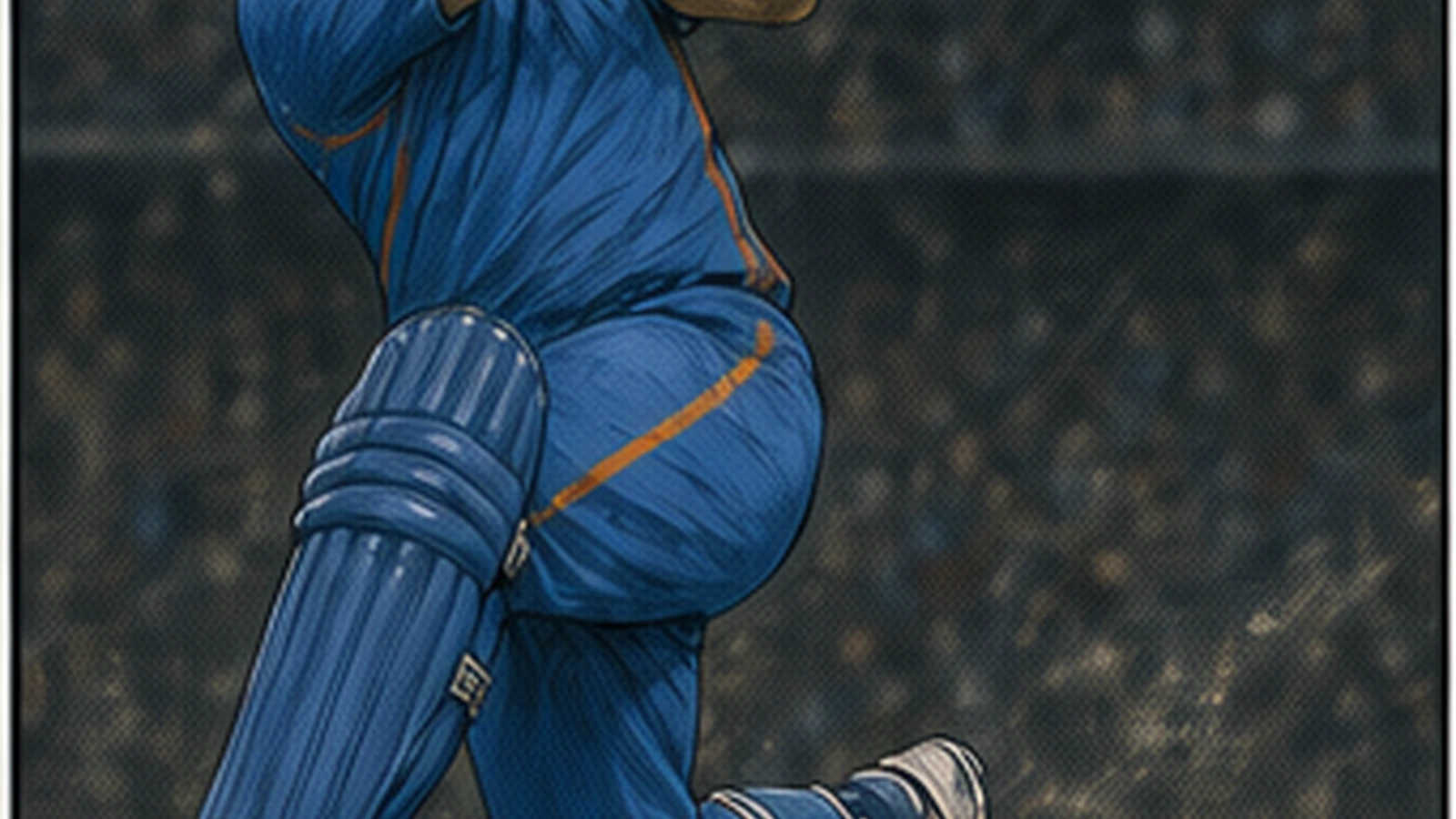
Five balls had disappeared. Stuart Broad still had to run in once more.
At the non-striker's end, India captain Mahendra Singh Dhoni believed the sixth six was coming. He later remembered that the Indian players had begun expecting it after the fourth. Yuvraj Singh felt the pressure differently. Years later, he told the International Cricket Council that after the fifth six, he had butterflies in his stomach.
Broad delivered. Yuvraj swung through the line and sent the ball wide of mid-on. It cleared the boundary.
Six legal deliveries. Six sixes. Thirty-six runs from one over.
The sequence is often described as an eruption of anger. Moments before it began, Yuvraj had exchanged heated words with Andrew Flintoff. But anger alone cannot explain what happened next. Broad changed his line. He changed his length. He changed his angle. Yuvraj answered every adjustment with a different shot into a different part of Kingsmead.
This was not one mistake repeated six times. It was six problems solved in less than four minutes.
The match took place on the nineteenth of September, 2007, at Kingsmead in Durban. It was the first ICC World Twenty20, a tournament being played before international cricket had fully decided what the shortest format should become.
India arrived in South Africa with a young squad and limited Twenty20 experience. Sachin Tendulkar, Rahul Dravid and Sourav Ganguly had opted out. Mahendra Singh Dhoni was leading India for the first time in international cricket. According to the BCCI's retrospective, eight members of the fifteen-player squad had not played a Twenty20 international before the tournament.
The format was new. The pressure was not.
India's opening match against Scotland had been abandoned. Their match against Pakistan finished level before India won a bowl-out. Then New Zealand beat them by ten runs.
That defeat created a simple qualification demand. India needed to beat England and then South Africa to reach the semi-finals.
England came first.
India won the toss and chose to bat. Virender Sehwag and Gautam Gambhir built the innings together. They did not play as if survival was the objective. They added one hundred and thirty-six for the first wicket in fourteen overs and four balls.
Sehwag made sixty-eight from fifty-two deliveries, with four fours and three sixes. Gambhir made fifty-eight from forty-one, with seven fours and one six. Their partnership created control, but both openers were gone by the middle of the sixteenth over.
Robin Uthappa followed at the end of the seventeenth. India were one hundred and fifty-five for three after sixteen overs and four balls.
Yuvraj Singh walked in with only twenty legal deliveries remaining.
That detail matters. He did not have the time available to a top-order batter who can observe the surface, build an innings and wait for the weakest bowler. His role was compressed. India already had a useful platform. Yuvraj had to turn it into a total capable of surviving England's chase.
He began quickly. By the end of the eighteenth over, India had reached one hundred and seventy-one for three.
Then Yuvraj and Andrew Flintoff exchanged words.
The ICC's official retrospective describes the exchange as heated. It is tempting to treat it as a complete explanation, as if one argument mechanically produced six sixes. That would replace skill with mythology. The exchange changed Yuvraj's emotional state, but emotion still had to survive the next six deliveries.
Flintoff's over was finished. Stuart Broad had the nineteenth.
Broad was twenty-one. He was an emerging England fast bowler, early in a career that would eventually make him one of his country's leading international wicket-takers. On this night, he inherited an angry batter, a closing innings and almost no margin for error.
The score was one hundred and seventy-one for three.
Broad ran in for the first ball.
The delivery entered Yuvraj's hitting arc. Yuvraj cleared his front leg, swung cleanly and launched the ball over long-on. The ICC's account says it landed outside the ground.
That was six, but it was not yet a pattern. Batters often begin an over with a boundary. Bowlers adjust. Captains move the field. The contest returns to negotiation.
Broad had five balls to restore that negotiation.
He changed the line for the second. Yuvraj remained upright, allowed the pace to reach him and flicked the ball over backward square leg.
The first six had travelled in front of the wicket. The second went behind square on the leg side. Defending one boundary would not protect the other.
Twelve runs had come from two balls.
Broad tried again. The third delivery offered width outside Yuvraj's reach. Yuvraj extended his arms and sent it over extra cover.
Three balls. Three sixes. Three areas of the field.
The technical problem was widening. Bowl straight and Yuvraj could swing through long-on. Move towards his body and his wrists could redirect the pace behind square. Offer width and he could reach through the off side.
Broad still needed to deliver half the over.
For the fourth ball, he changed the geometry and came around the wicket. It was a sensible response. A different angle could cramp Yuvraj, alter the hitting line and make him generate power from a less familiar position.
The ball became a full toss. Yuvraj carved it over backward point.
Twenty-four runs from four deliveries.
At the non-striker's end, Dhoni had watched every ball. He later wrote that after the fourth six, the Indian players were quite sure Yuvraj would hit six in the over.
Expectation had changed sides. At the start, Broad was expected to complete an over and Yuvraj was trying to maximise it. Now the crowd was counting down, India were anticipating history and Broad was trying to prevent the sequence from becoming permanent.
The fifth ball arrived. Yuvraj lowered himself onto one knee and struck it over midwicket.
Thirty runs from five balls.
This was where certainty disappeared for Yuvraj. The first five swings had created an opportunity that almost no batter receives. One more clean contact would make him the first player to hit six sixes in an over in a Twenty20 international.
At the ICC awards the following year, Yuvraj recalled feeling butterflies before the sixth. The admission gives the achievement its human scale. He was not unconscious of the record. He knew exactly what the last ball could mean.
Broad had already tried changing line, length and angle. Now he had to deliver while everyone in the ground understood the same possibility.
He ran in.
Yuvraj struck through the ball and sent it wide of mid-on. It travelled beyond the rope.
The score moved from one hundred and seventy-one for three at the beginning of the over to two hundred and seven for three at the end.
Yuvraj had also reached fifty from twelve balls. At that moment, it was the fastest half-century in Twenty20 international cricket.
That record needs a precise definition. It stood as the unrestricted record for sixteen years. In 2023, Nepal's Dipendra Singh Airee reached fifty from nine balls against Mongolia at the Asian Games and became the overall record holder. But as of the twenty-seventh of August, 2026, Yuvraj's twelve-ball fifty remains the fastest men's T20 international fifty in a match between two ICC Full Members. It is no longer the overall record, but it still leads that highest-level match-up category and remains the benchmark that defined T20's formative international years.
There is another record distinction worth preserving. In 2024, Darius Visser of Samoa helped produce a thirty-nine-run over in a men's T20 international, aided by extra deliveries. That surpassed thirty-six as the highest-scoring men's T20I over. Yuvraj's feat remains different and exact: every one of six legal balls went for six.
The innings still had one over remaining.
Yuvraj added eight more runs before Flintoff dismissed him with the fifth ball of the twentieth over. He finished with fifty-eight from sixteen deliveries, including three fours and seven sixes. His strike rate was three hundred and sixty-two point five.
India finished on two hundred and eighteen for four. Broad's figures were four overs, no wickets and sixty runs.
It would be easy to end the story there, with a scoreboard frozen on the damage. But England still had an innings, and the meaning of Yuvraj's over depended on the chase.
England attacked. Darren Maddy made twenty-nine from twenty balls. Vikram Solanki made forty-three from thirty-one. Kevin Pietersen scored thirty-nine from twenty-three. Paul Collingwood made twenty-eight from twenty.
The chase did not collapse. England scored at exactly ten runs per over and reached two hundred for six.
India won by eighteen runs.
The thirty-six taken from Broad's over was twice the final margin, but that does not mean cricket can be solved by simply removing those runs. A different target changes a chase. Batters take different risks. Captains use bowlers differently. Fields move. The responsible conclusion is not that one subtraction proves an alternate result.
The responsible conclusion is that Yuvraj transformed a strong total into one England could not reach.
He was named Player of the Match.
India's qualification problem was only half solved. They still had to face South Africa, the host nation, the next day.
India were reduced to sixty-one for four, but Rohit Sharma and Dhoni rebuilt the innings. India reached one hundred and fifty-three for five. Then their bowlers and fielders overwhelmed South Africa. RP Singh took four wickets for thirteen runs. India won and reached the semi-finals.
Australia waited there.
Yuvraj returned to Kingsmead and produced another innings of controlled violence. He made seventy from thirty balls, with five fours and five sixes. India reached one hundred and eighty-eight for five and won by fifteen runs.
The six-sixes over was no longer an isolated spectacle. Yuvraj had delivered decisive acceleration in two of India's most important matches.
India then faced Pakistan in the final in Johannesburg. Gautam Gambhir made seventy-five. India set Pakistan one hundred and fifty-eight to win. The chase reached the final over, and Misbah-ul-Haq reduced the requirement to six runs from four balls with one wicket remaining.
Misbah attempted to scoop Joginder Sharma. Sreesanth completed the catch at short fine leg.
India became the first men's T20 world champions.
That victory changed the context around Durban. Had India failed to qualify, the six sixes would still have been extraordinary. Because India continued through South Africa, Australia and Pakistan, the over became the most concentrated symbol of a championship campaign.
It represented the way the team met uncertainty. A young squad entered a new format without many of India's established stars. The tournament demanded decisions before convention had supplied all the answers. In Durban, Yuvraj responded to that uncertainty by attacking six times without losing shape.
The ICC recognised the performance in 2008, making Yuvraj the inaugural winner of its Twenty20 International Performance of the Year award. The award placed the over alongside the defining achievements of cricket's rapidly growing format.
Broad's later career adds another dimension. He did not disappear after Durban. He recovered, learned and developed into one of England's leading bowlers. The over remained attached to his name, but it did not establish the ceiling of his career.
That matters because sport often turns one bad sequence into a verdict. Broad's response demonstrated that a public failure can become part of a career without becoming its conclusion.
Yuvraj's achievement also survives without turning Broad into a permanent victim. The quality of the over lies partly in the fact that an international fast bowler kept adjusting and an international batter kept finding an answer.
Long-on and out of the ground.
Backward square leg.
Extra cover.
Backward point.
Midwicket.
Wide of mid-on.
Six different destinations. Six consecutive decisions. No illegal delivery and no seventh ball required.
The argument with Flintoff supplied heat. The match supplied pressure. The tournament supplied consequence. But Yuvraj still had to move his feet, control the bat face and generate clean power while the field, bowler and expectation changed around him.
Before the final delivery, he felt the record approaching. Broad began his run. Yuvraj committed to the swing.
For a few seconds, the ball travelled through the Durban night and every possible ending remained open.
Then it cleared the boundary, and six deliveries became cricket history.