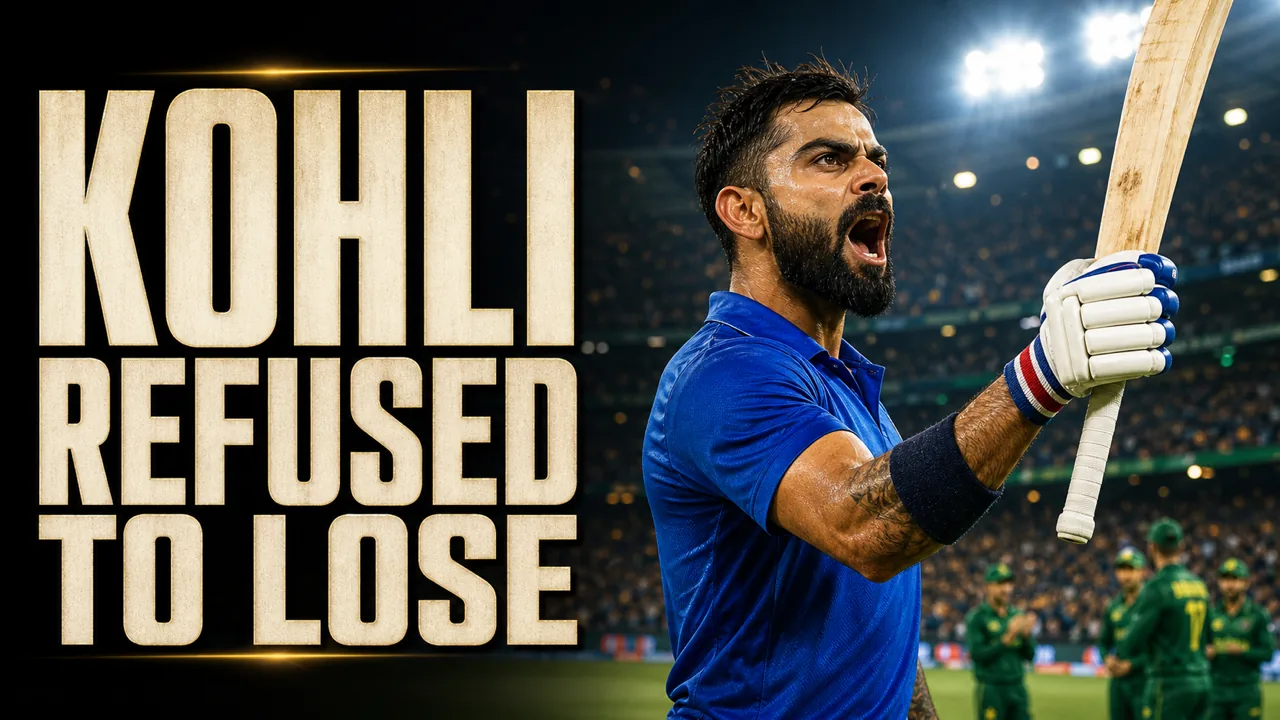
There are innings built on freedom, when the pitch is true, the required rate is comfortable and every attacking option appears available. Virat Kohli’s unbeaten 82 against Pakistan at the Melbourne Cricket Ground was not one of them.
This was an innings built inside a crisis.
India were chasing 160 in their opening match of the 2022 Men’s T20 World Cup when Pakistan’s fast bowlers tore through the top order. KL Rahul, Rohit Sharma and Suryakumar Yadav were gone inside the powerplay. Axar Patel followed at the beginning of the seventh over. India were 31 for four, the target was disappearing into the distance, and more than 90,000 people inside the MCG were watching the pressure settle on Kohli.
The obvious temptation was to attack immediately. Kohli chose control.
He and Hardik Pandya understood that India could not win the match in the middle overs, but they could lose it there. The partnership therefore began as an exercise in survival: protect the remaining wickets, keep the chase alive and wait for Pakistan’s bowling plan to present an opening.
That patience was essential because the required rate continued to rise. Pakistan’s quick bowlers had pace, movement and the confidence created by early wickets. Kohli could not simply manufacture boundaries without exposing India’s final recognised partnership. Pandya’s presence gave him support, but the burden of managing the chase remained with the batter whose reputation had been built on finishing difficult pursuits.
India still needed 48 from the final three overs.
At that point, calculation had to become confrontation. Kohli later explained that Mohammad Nawaz still had an over to bowl, so India’s route back into the match depended on unsettling Pakistan before the spinner returned. Shaheen Shah Afridi’s final over went for 17. The target was still demanding, but it no longer looked impossible.
Then came Haris Rauf.
With 28 required from eight deliveries, Kohli produced the shot that came to define the match. Rauf delivered a slower ball on a hard length. Kohli stayed balanced, drove through the line and sent it straight back over the bowler’s head for six. It was neither a slog nor a desperate swing. It was a technically controlled response to a situation that offered almost no margin for error.
The following delivery disappeared over fine leg. Two balls had reduced the equation to 16 from the final over, and the pressure had changed sides.
The finish was chaotic. Pandya was dismissed from the first delivery of Nawaz’s over. Kohli then struck a waist-high full toss for six, earning a no-ball. He was bowled from the free hit, but the ball remained live and India ran three byes. Dinesh Karthik was stumped with two still required, before Ravichandran Ashwin allowed a wide to pass and then lifted the final delivery over mid-off for the winning run.
Ashwin completed the chase, but Kohli had made it possible.
He finished unbeaten on 82 from 53 balls, with six fours and four sixes. His partnership with Pandya carried India from 31 for four to the edge of victory, and India reached 160 for six to win by four wickets from the final ball.
The numbers describe the innings, but they do not fully explain it. Kohli’s achievement was not simply that he scored quickly at the end. It was that he recognised when not to attack, accepted the rising required rate without surrendering his wicket, and preserved enough clarity to identify the precise moment when risk became unavoidable.
The two sixes from Rauf’s final over will always dominate the highlights. The first, struck back over the bowler’s head, was later voted the ICC Men’s T20 World Cup’s greatest moment in a 2024 fan poll. Yet the shot mattered because of everything that preceded it: the early collapse, the controlled rebuilding, the partnership with Pandya and the refusal to confuse urgency with panic.
Kohli later placed the innings above his celebrated unbeaten 82 against Australia in Mohali in 2016. The comparison was understandable. Melbourne brought together the largest stage, India’s fiercest rivalry, a collapsing chase and a finish in which almost every delivery carried the match in a different direction.
In Mohali, Kohli mastered a pursuit. At the MCG, he rescued one.
That distinction is what made the innings extraordinary. India did not require a conventional T20 assault. They required someone to absorb the fear of defeat, keep making rational decisions and then produce the irrational-looking strokes that the final equation demanded.
On 23 October 2022, Kohli did all three.