For 29 years, India against Pakistan at a men’s World Cup had followed one unbroken rule: India always won.
Seven victories had come in the 50-over World Cup and another five in the T20 World Cup. Twelve meetings, twelve Indian wins. Pakistan had produced great teams, legendary players and countless memorable performances during that period, but whenever these two nations met on the World Cup stage, the result remained the same.
Then came Dubai on 24 October 2021.
Pakistan won the toss and chose to bowl. Beneath the lights of the Dubai International Cricket Stadium, with millions watching around the world, they had another opportunity to break a record that had followed them since the rivalry’s first World Cup meeting in 1992.
This time, there was a fire in the heart of the Pakistan cricket team.
Shaheen Shah Afridi was given the new ball. He was only 21 years old, but the responsibility placed in his hands could hardly have been greater. At the other end stood Rohit Sharma, one of the finest white-ball batters of his generation.
Shaheen did not need long.
The fourth ball of the match swung back into Rohit at speed. Trapped in front of his stumps, Rohit was dismissed without scoring. India were one wicket down before they had placed a run on the board.
The breakthrough was important, but what followed made the opening spell unforgettable.
In Shaheen’s next over, KL Rahul was beaten by a delivery that moved back into him and crashed into the stumps. India were six for two. Two of their most dangerous batters were gone, and the pressure created by decades of World Cup history had suddenly changed direction.
For years, Pakistan had been the team carrying the weight of the record. Now India were the side being asked to respond.
Suryakumar Yadav briefly attempted to counterattack, but he was dismissed for 11. India slipped to 31 for three, leaving Virat Kohli and Rishabh Pant with the responsibility of rebuilding the innings.
Pant supplied the aggression. He made 39 from 30 balls, including two inventive one-handed sixes, and helped India recover from the damage caused by Pakistan’s opening spell. Kohli, meanwhile, played the type of innings demanded by the situation. He absorbed pressure, found the gaps and held the innings together while wickets fell around him.
Their partnership gave India hope, but Pakistan never completely released their grip on the game.
Shadab Khan removed Pant, while Hasan Ali accounted for Suryakumar and Ravindra Jadeja. Kohli reached his half-century and carried India beyond 130 before Shaheen returned for his final over.
The bowler who had transformed the beginning of the innings would also have the final word against India’s captain.
Kohli attempted to attack a shorter delivery but could only offer a catch behind the stumps. He departed for 57 from 49 balls. Shaheen finished with three wickets for 31 runs, having dismissed Rohit, Rahul and Kohli—the three wickets Pakistan would have wanted most.
India closed on 151 for seven.
It was a competitive total, particularly in a contest carrying this much pressure. Pakistan still needed to complete the chase, and the history of the fixture meant that no target would feel straightforward.
Babar Azam and Mohammad Rizwan walked out knowing that one early mistake could bring the entire weight of the occasion rushing back.
India needed one wicket.
It never came.
Babar and Rizwan did not approach the chase like two batters frightened by the record behind them. They played as if the only things that mattered were the target in front of them and the next delivery.
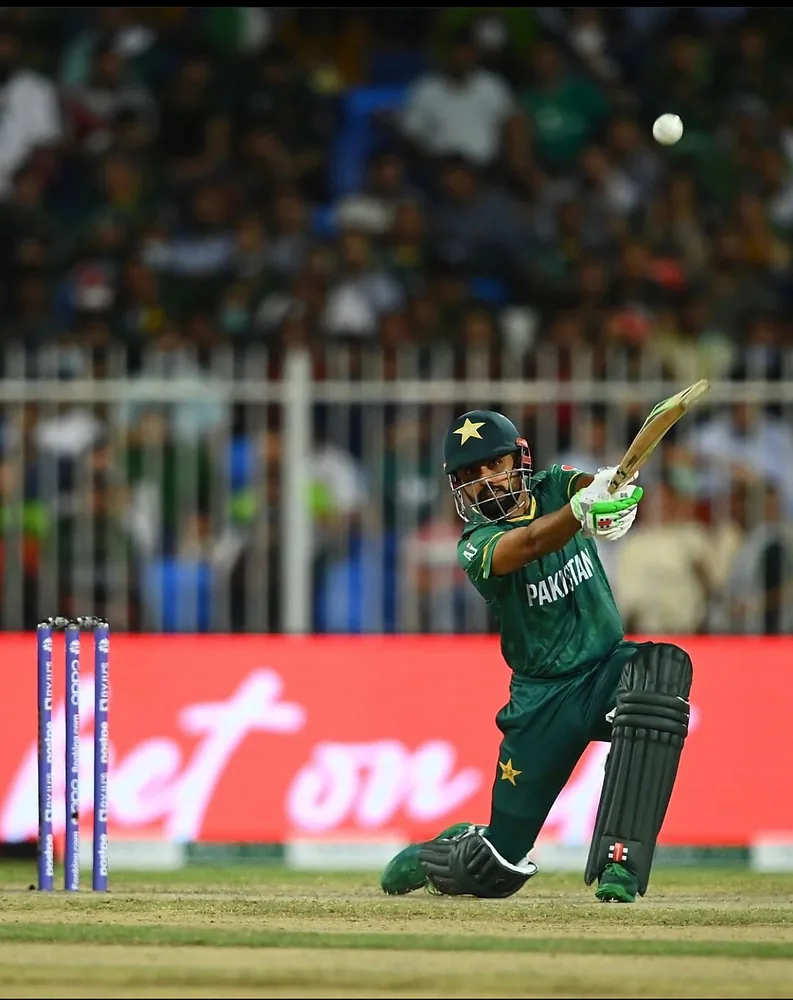
Rizwan attacked early. Babar brought his usual control, timing and calmness. Neither allowed India’s bowlers to create sustained pressure, and every over without a wicket made Pakistan’s long wait feel closer to its end.
India tried Jasprit Bumrah, Mohammed Shami, Bhuvneshwar Kumar, Varun Chakravarthy and Ravindra Jadeja. Different angles were attempted and different fields were set, but the breakthrough never arrived.
Babar reached his half-century. Rizwan followed him.
The partnership passed 100, and the impossible began to look inevitable.
Babar finished unbeaten on 68 from 52 balls. Rizwan ended on 79 not out from 55. Together, they reached 152 without losing a wicket, completing the chase in 17.5 overs with 13 balls remaining.
Pakistan had won by ten wickets.
It was their first victory over India in 13 attempts across the men’s ODI and T20 World Cups. It was also Pakistan’s first ten-wicket victory in a men’s T20 international and India’s first defeat by that margin in the format.
But the meaning of the result could not be contained by statistics alone.
For Pakistan, this was redemption. Shaheen had shattered India’s top order before Babar and Rizwan completed the job with an unbeaten partnership. Three of the country’s brightest players had delivered on one of cricket’s largest stages.
The victory did not erase the previous 12 defeats, but it changed the way the story could be told. The record was no longer a prediction of what would always happen. It had become history.
For India and their supporters, the defeat was painful precisely because the occasion mattered so much. When the hopes of millions rest on 11 players competing miles away, a match can make the world feel as though it has stopped. Hearts pause. Streets empty. Every delivery becomes an event of its own.
There were no excuses for the result. Pakistan were better with the new ball, calmer during the chase and more decisive in the moments that shaped the match.
The victory became the beginning of an excellent group stage for Pakistan. They won all five of their Super 12 matches and advanced to the semi-finals as the only unbeaten team in their group. Their tournament ultimately ended against Australia, who completed a dramatic five-wicket chase in Dubai.
That later defeat prevented Pakistan from lifting the trophy, but it did not diminish what happened against India.
World Cups are remembered through moments: a delivery that moves late, a batter refusing to give away his wicket, a partnership that makes pressure disappear and a result that changes how a rivalry is understood.
Revenge does not always leave the best taste in one’s mouth. But in Dubai that night, after 29 years of waiting, Pakistan tasted victory.
And it surely tasted sweeter than sugar.
Original story written by a human. AI-generated editorial visuals and synthetic narration.