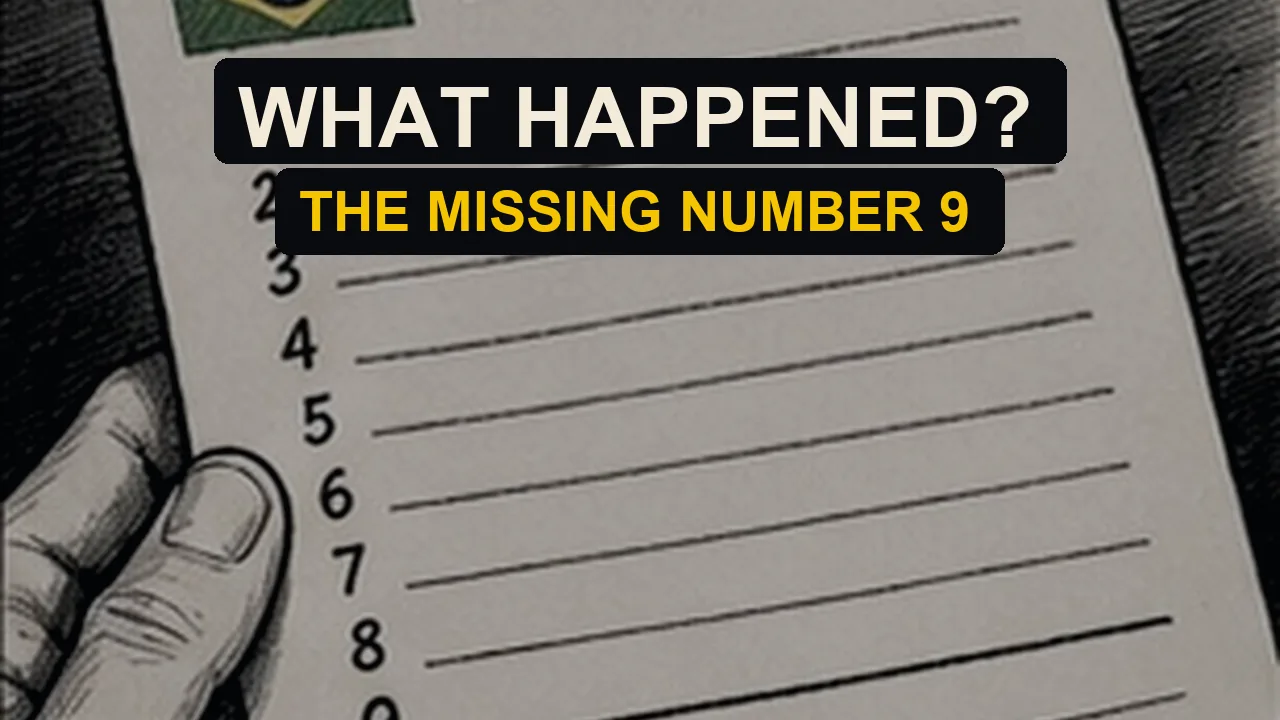
The first version of Brazil’s team sheet for the 1998 World Cup final contained an astonishing absence. Ronaldo, the most feared young forward on the planet, was not in the starting eleven.
Then another team sheet appeared. Ronaldo was back.
Between those two documents sat a medical emergency, a visit to hospital and a decision that remains debated decades later. France would win the final three-nil, Zinedine Zidane would become a national hero, and Brazil’s greatest attacking threat would appear strangely subdued. But before anybody could understand the match, they had to understand why Ronaldo was playing at all.
The phenomenon
Ronaldo was only twenty-one, but he had already become the face of a new football age. His acceleration was violent, his close control survived at full speed and his finishing seemed almost mechanical. Defenders could anticipate his direction and still fail to stop him.
He had been part of Brazil’s 1994 World Cup squad without playing. By 1998, he was no passenger. He scored four times in France, created chances and carried the expectation attached to Brazil’s number nine. The reigning world champions had Rivaldo, Bebeto, Roberto Carlos and Cafu, yet Ronaldo was the player around whom global attention gathered.
Brazil reached the final after surviving the Netherlands on penalties in the semifinal. Their opponents were the hosts, playing at the Stade de France. It was a perfect stage for a superstar: Brazil pursuing a fifth title, France seeking a first, and Ronaldo positioned as the heir to football’s greatest names.
Then, on the afternoon of the final, the story changed.
What happened in the hotel
Ronaldo later described suffering a convulsion after lunch. For several minutes, he was unconscious. Teammates witnessed the episode. Roberto Carlos, who was sharing a room with him, became central to the immediate response.
The exact medical explanation was not publicly settled. Ronaldo later said that even after extensive examinations, no definitive cause had been established. Stress and pressure were discussed as possibilities, but uncertainty remained.
For Brazil’s staff, the urgent question was practical. Could he safely play a World Cup final only hours later?
Ronaldo was taken for hospital tests. In the meantime, Brazil prepared a line-up without him. Edmundo was listed to start. That first team sheet reached officials and media, setting off confusion around the stadium. A World Cup final was approaching and the tournament’s biggest star had vanished from the team.
The information environment of 1998 made the mystery more intense. There were no social-media updates from inside the camp, no instant video explanations and no reliable stream of detail. Rumour filled the silence. Was Ronaldo injured? Had there been a disciplinary problem? Was the team sheet an error?
Then Brazil submitted a revised line-up. Ronaldo would start after all.
The decision to play
Ronaldo returned from hospital after tests reportedly found no condition that prevented him from playing. He told the coaching staff he wanted to be selected. Mario Zagallo restored him to the eleven.
That sequence later generated theories involving sponsors and commercial pressure. Ronaldo publicly rejected the claim that Nike had forced Brazil to play him. He said the decision followed medical tests and his own insistence that he felt able to take part.
It is important to separate the documented sequence from speculation. Ronaldo suffered a serious episode. He was initially omitted. He underwent tests. He returned and said he could play. The staff selected him. There is no established evidence that a sponsor dictated the line-up.
But even without conspiracy, the decision remains difficult. A player can be medically cleared and still be far from ready for elite competition. A World Cup final is not a normal workplace. It concentrates personal ambition, national expectation and institutional pressure into one decision. Ronaldo had spent his young life moving toward that night. Saying he did not want to play may have felt impossible.
The question is therefore not only whether he passed a medical test. It is whether any twenty-one-year-old superstar, hours after losing consciousness, could make a truly free choice in that environment.
France take control
Once the match began, Brazil never looked comfortable. France were organised, aggressive and energised by the home crowd. Zidane scored twice with headers from corners in the first half. Emmanuel Petit added a third goal late in the match.
The final score was France three, Brazil nil.
Ronaldo played the full match but produced little of the explosiveness that had defined his tournament. He managed one notable effort, saved by Fabien Barthez. He was present, yet the version of Ronaldo the world expected did not appear.
It would be too simple to explain the entire result through one player’s condition. France were excellent. Their midfield controlled the contest, their defence limited Brazil and their set pieces punished weaknesses. Brazil also had broader tactical problems. A final involving twenty-two starters cannot honestly be reduced to a single medical episode.
Still, Ronaldo’s ordeal shaped the atmosphere. Teammates had seen him collapse. The line-up had changed and changed back. The squad entered the biggest match of their careers after an afternoon of fear and uncertainty. Even if every player tried to focus, the disruption was real.
Why the mystery survived
The story endured because it joined an unexplained health event to a shocking sporting performance. If Brazil had won, the episode might have become a tale of courage. If Ronaldo had scored, his return might have been celebrated without much interrogation. Instead, the favourites lost heavily and their star looked diminished.
That created a vacuum for alternative explanations. The commercial scale of Ronaldo’s fame made sponsor theories feel plausible to some observers. Brazil’s status made political and organisational rumours inevitable. The lack of a single confirmed medical cause ensured that certainty never arrived.
But mystery should not be confused with permission to invent. The strongest version of the story is already extraordinary.
One of the world’s most famous athletes suffered a convulsion on the day of a World Cup final. His name disappeared from the starting line-up. After hospital tests, it returned. He played, Brazil lost, and two physical team sheets preserved the confusion of those hours.
The human being inside the icon
Ronaldo’s image in 1998 had been built around unstoppable movement. He was marketed and discussed as the Phenomenon, a player who seemed to belong to the future. The final exposed the vulnerability beneath that image.
Sport often treats availability as a simple switch. A player is fit or unfit, selected or omitted. The Ronaldo episode shows how inadequate those categories can be. Medical clearance, emotional readiness and competitive desire are different things. They can point in different directions at exactly the wrong time.
It also raises a question that elite sport still struggles with: who protects a player when the player desperately wants to continue? Modern protocols are more formal in many areas, particularly around concussion and cardiac risk, but the tension remains. The most driven athletes are often the least likely to remove themselves.
Ronaldo was not merely an asset Brazil could deploy. He was a frightened young man trying to understand what had happened to his body while the largest match in football moved toward kick-off.
Redemption in 2002
Four years later, the image changed again. Ronaldo entered the 2002 World Cup after severe knee injuries had threatened his career. This time, he scored eight goals. In the final against Germany, he scored twice and Brazil won two-nil.
The comeback did not solve the medical mystery of Paris. It changed what the 1998 final meant within his life. The defeated and subdued number nine became the champion who returned from years of rehabilitation to decide another World Cup.
That second final is why Ronaldo’s career cannot be defined by the first. Yet the contrast makes 1998 even more haunting. In Paris, the most explosive footballer of his generation reached the greatest stage after an event neither he nor the public fully understood.
France deserved their victory. Zidane deserved his place in history. Ronaldo’s condition should not be used to erase either fact.
But behind the scoreline is a story about pressure, uncertainty and the limits of sporting mythology. The player known as the Phenomenon was expected to be superhuman. For a few frightening hours, the world was reminded that no athlete is.