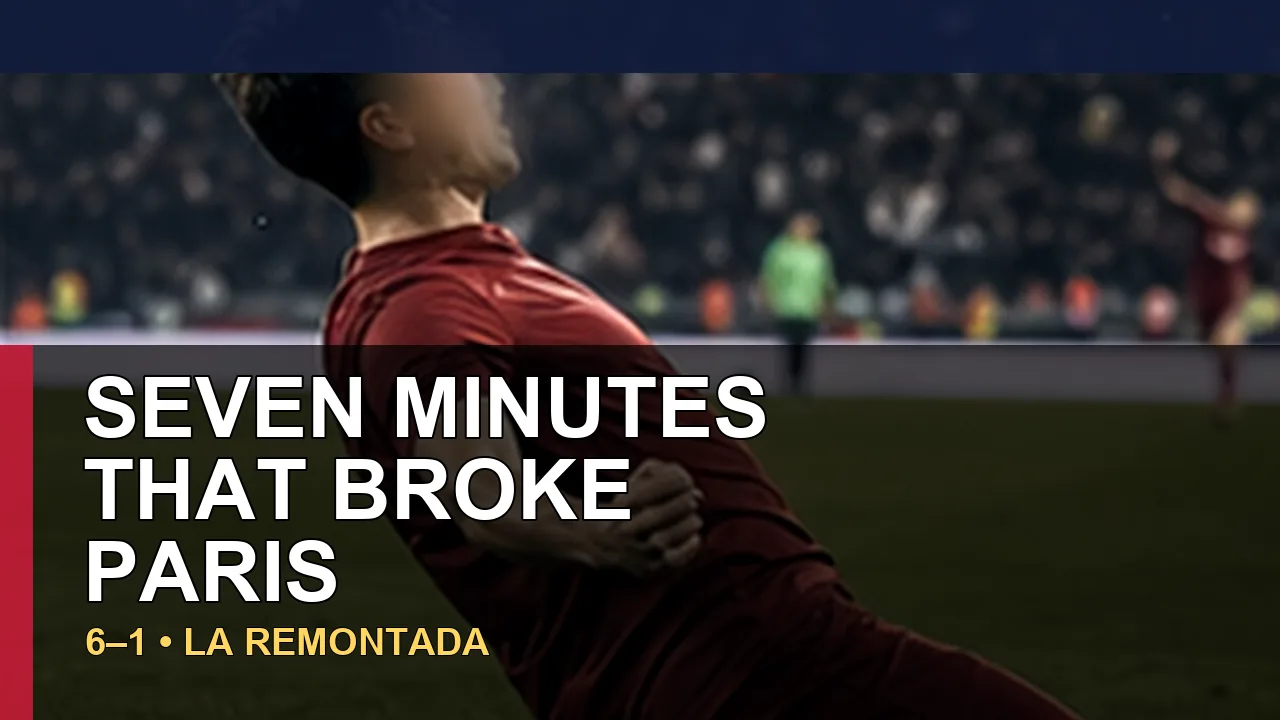
Barcelona entered the second leg against Paris Saint-Germain requiring a result that no team had previously achieved in the European Cup or Champions League: overturning a four-goal first-leg deficit.
Paris had won 4–0 in France. Barcelona therefore needed four unanswered goals to force extra time. If Paris scored at the Camp Nou, the away-goals rule meant Barcelona would require six.
The first leg made the challenge feel larger than its score. Paris had not stolen four goals through isolated accidents. They had overwhelmed Barcelona, denied them rhythm and created the impression that the balance of power had shifted decisively. The return match therefore demanded more than goals. Barcelona had to overturn the memory of being controlled. Every early pass carried a psychological question: did the players believe in the comeback, or were they only obliged to speak about belief because the second leg still had to be played?
The Camp Nou supplied an answer before the football could. The atmosphere treated the tie as unfinished. That did not alter the mathematics, but it changed the conditions in which those mathematics would be tested. Paris had arrived with the safer score. Barcelona began with the clearer emotional task. The hosts had to attack because no other option existed. The visitors had to decide how aggressively to protect an advantage that should already have been enough.
That rule shaped every phase of the second leg. Barcelona could not think only about scoring; they also had to prevent the single Paris goal that would multiply the difficulty. Paris possessed both the advantage and the counterattacking threat to use Barcelona’s urgency against them. The tie invited the hosts to attack with abandon while punishing the smallest loss of control.
Hope needed an immediate beginning, and Luis Suárez provided it inside three minutes. He reached a bouncing ball before Kevin Trapp and headed it over the line. The goal did not make the task reasonable, but it made the stadium participate in the possibility.
Barcelona’s pressure produced a second goal before half-time when Layvin Kurzawa turned Andrés Iniesta’s improvised attempt into his own net. Lionel Messi converted a penalty early in the second half. Barcelona were 3–0 ahead on the night and one goal from levelling the tie.
Each goal altered Paris’s relationship with the clock. At nil–nil, every minute removed part of Barcelona’s opportunity. At three–nil, time no longer felt like protection. It felt like a space in which the fourth goal could arrive. The visitors were still ahead on aggregate, but the match was now being played almost entirely according to Barcelona’s emotional rhythm. The crowd reacted not only to chances but to recoveries, appeals and every sign that Paris were becoming uncomfortable.
Barcelona’s method was deliberately overwhelming. Players occupied aggressive positions, the defensive line advanced and possession was recycled before Paris could escape the pressure. The risk was obvious. One clean counterattack could produce the away goal that would force Barcelona to score six. But caution offered no route through the tie. The only sensible plan was one that looked unreasonable under normal circumstances.
Then Edinson Cavani scored.
His 62nd-minute finish changed the requirement completely. Because of the away-goals rule, Barcelona now needed three more goals. The energy inside the Camp Nou could not alter the arithmetic. Paris had restored control with one decisive attack.
Cavani’s goal was devastating because it seemed to expose the limit of belief. Barcelona had spent an hour moving a mountain and Paris had shifted it back with one strike. The away section celebrated release; the home crowd confronted the possibility that the three earlier goals would become impressive but irrelevant. Even Barcelona’s players appeared to lose some of the clean urgency that had driven the opening phase.
For Paris, however, the goal introduced a subtle danger. Their task appeared complete, and the mind behaves differently when it believes it has escaped. The visitors no longer needed to imagine how to survive a siege for ninety minutes. They needed only to guide a comfortable aggregate advantage through the final half hour. That sounds easier, but it can encourage passivity. Instead of asking how to hurt Barcelona, Paris increasingly asked how little time remained.
The goal should have settled the contest. It gave Paris something more powerful than momentum: a margin that seemed immune to ordinary football. Barcelona now needed to score at a rate the remaining time did not reasonably allow. Every passing minute strengthened Paris’s position, and every unsuccessful attack appeared to confirm that the first hour had only delayed elimination.
As the match entered its final minutes, the comeback appeared finished. Barcelona had spent enormous physical and emotional energy reaching the edge of history, only for Cavani’s goal to move it away again.
What followed is why the match became known simply as La Remontada.
Neymar curled a free-kick into the top corner in the 88th minute. The score was 4–1 on the night. Barcelona still needed two.
The free-kick was the moment the impossible returned without warning. It was not merely another goal. Its quality removed the time normally required to construct a chance and struck before Paris could organise another phase of resistance. A contest that had appeared finished at the 87th minute was suddenly alive at the 88th. The scoreboard still favoured Paris, but the stadium no longer behaved as though it did.
In stoppage time, Suárez won a penalty and Neymar converted it. Five–one. One more goal was required, but almost no time remained.
Paris had moved from safety to survival in minutes. Every clearance was now an attempt to end the match. Barcelona sent goalkeeper Marc-André ter Stegen forward for a late free-kick. The initial delivery was cleared, but possession returned to Neymar. He shaped a cross into the penalty area, and substitute Sergi Roberto ran beyond the defensive line.
By this stage, tactics and panic had become almost impossible to separate. Barcelona had committed bodies because there was no future to protect. Paris knew a single clean clearance could deliver qualification, yet that knowledge made every touch heavier. The pressure was not created only by the number of attackers. It was created by the proximity of the finish. The closer Paris moved to the whistle, the more unbearable the idea of losing became.
This is one of football’s cruelest psychological reversals. A team chasing a miracle can eventually become free because failure was expected. A team protecting certainty can become trapped because success has already been mentally possessed. Barcelona’s players could act. Paris’s players increasingly reacted. One side saw a final opportunity in every loose ball; the other saw a new way for safety to disappear.
That run represented the final gamble. Paris’s defenders were watching the ball and trying to hold a line for only a few more seconds. Roberto attacked the space between certainty and the whistle. Neymar’s delivery had to clear the first defenders without carrying through to the goalkeeper. There was no opportunity to correct either decision. The match had been reduced to one pass, one run and one touch.
Roberto reached the ball and lifted it past Trapp in the 95th minute.
Barcelona won 6–1 and advanced 6–5 on aggregate.
The final seven minutes are remembered as an eruption, but the comeback was built from conflicting forces. Barcelona’s belief was necessary; so was Paris’s fear. The closer the hosts moved toward the impossible, the more the visitors’ four-goal advantage stopped functioning as protection and began to feel like something that could be lost.
That does not mean the comeback can be explained by mentality alone. Belief without delivery is just a slogan. Neymar still had to execute the free-kick, score the penalty under extraordinary pressure and lift the final pass into the exact area Roberto was attacking. Roberto still had to time a run through a crowded line and control a difficult finish with one touch. Ter Stegen had to leave his goal, Barcelona had to recover the cleared ball, and the whole team had to accept that a failed gamble no longer mattered. Psychology created the willingness. Technique completed the event.
The away-goals rule intensified every decision. At four–nil, another Barcelona goal would have forced extra time. After Cavani scored, there was no intermediate reward. Barcelona needed three. That requirement made the late sequence binary: complete the most dramatic recovery imaginable or leave the competition. There was no respectable partial comeback available. The structure of the rule helped create the extremity of the ending.
The stadium amplified that reversal. Earlier, the crowd had responded to each goal as another step along an almost impossibly long road. After Neymar’s free-kick, the same noise became a source of immediate pressure. Paris no longer had the emotional space to consider the whole tie. They had to survive the next delivery, the next appeal and the next Barcelona player entering the penalty area.
Neymar was central to the decisive sequence. He scored the free-kick, converted the penalty and delivered the pass for Roberto’s winner. Messi was the team’s defining figure, but this particular escape belonged to Neymar’s refusal to allow the match to close.
The game also resists a simple heroic reading. Barcelona’s achievement was extraordinary, but Paris’s collapse remains inseparable from it. The French side had produced an almost perfect first leg and then watched their authority dissolve. Football’s most dramatic comebacks create two permanent memories: one side’s proof that nothing is over, and the other’s knowledge that it should have been.
For Paris, the trauma was not limited to conceding six goals. It was the sequence in which control disappeared. They had answered Barcelona’s first wave. They had scored the away goal. They had reached the final minutes with a margin that should have absorbed almost any late mistake. Then three separate moments arrived before the team could emotionally reset. The free-kick created alarm. The penalty created terror. Roberto’s touch ended the tie. There was scarcely enough time between them for Paris to restore the calm that had existed seconds earlier.
For Barcelona, the same compression created immortality. A more gradual comeback might have been admired as a superior team eventually establishing control. This was different. The hosts had to score while the match was running out of places to hide another attack. The urgency made every action visible and every success feel like a refusal of the clock itself.
La Remontada became a reference point because it expanded the range of scores that could still feel unstable. Four goals had represented certainty. After Barcelona, even that certainty carried an asterisk.
Its influence survives whenever a team scores early while chasing an overwhelming deficit. Commentators invoke Barcelona. Crowds begin calculating. Players are reminded that a match can change faster than their preparation can explain. Most attempted comebacks still fail, but this one ensures that the possibility cannot be dismissed before the football has answered it.
The achievement and the collapse will always be linked. Barcelona continued to create decisions under pressure; Paris made too many of those decisions poorly when safety appeared closest. That combination is why the match still feels less like a conventional comeback than a warning about certainty itself.
The lasting image is Roberto disappearing beneath teammates and supporters as the Camp Nou lost all restraint. Yet the defining feature of the match was time. In the 87th minute, Paris were safely through. By the 95th, Barcelona had completed the greatest comeback the competition had seen.
Seven minutes did not merely change the result. They changed what football allowed people to believe before the final whistle.
The match endures because it speaks to two truths at once. Scorelines matter, and certainty is fragile. Paris’s four-goal lead was real. Cavani’s away goal was real. Barcelona’s requirement was absurd. None of those facts prevented the next action from changing the emotional meaning of everything that came before it.
La Remontada should not be used to pretend that every deficit is recoverable. Most are not. Its power comes from rarity, from the collision of a near-perfect first leg with a second leg that broke the usual limits of time and pressure. It remains a warning against declaring a contest over while one team can still act.
In the end, Barcelona advanced because they converted belief into a sequence of exact decisions when exactness seemed least likely. Paris were eliminated because safety turned into hesitation at the worst possible moment. Between Neymar’s free-kick and Roberto’s finish, the tie crossed from mathematics into mythology.
That is why the final image still carries such force. Roberto falls, the stadium erupts and almost every Barcelona player runs towards the same corner. There is no composed celebration because composure belonged to the world that existed seven minutes earlier. The world after the goal required something else: disbelief made physical.