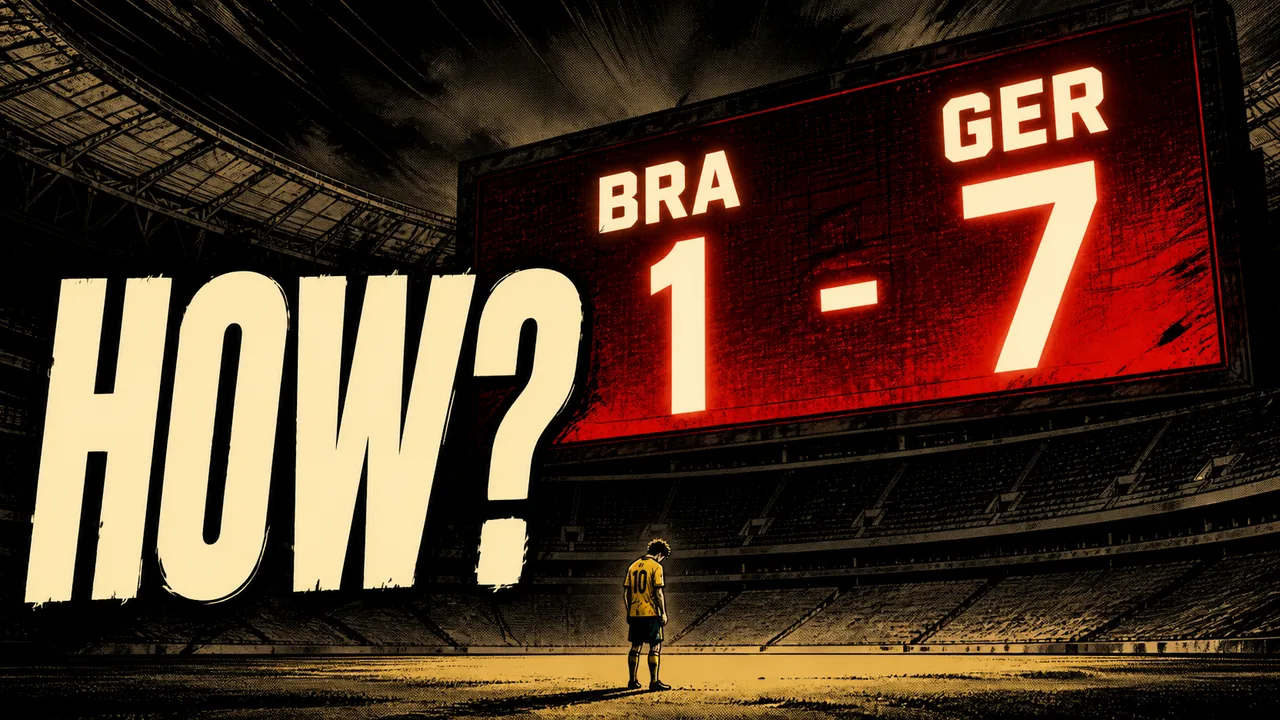
Brazil were losing two-nil in a World Cup semifinal at home. Six minutes and forty seconds later, they were five-nil down.
Players stopped defending as a team. Supporters cried and stared at a scoreboard that no longer seemed connected to reality. The most successful nation in World Cup history was collapsing before half-time.
How did Brazil disappear so quickly?
The answer begins with the result this tournament was supposed to erase. In 1950, Brazil had lost the decisive World Cup match to Uruguay inside the Maracanã. When the competition returned in 2014, the opportunity seemed obvious: win the trophy at home and replace the old wound with a celebration.
Brazil reached the semifinal. Ninety minutes against Germany stood between the hosts and another final in the Maracanã. Instead of completing the national story, the match created a second memory that would need no explanation beyond its score.
A team carrying more than a game
Brazil had not always played fluently during the tournament, but they had kept advancing. They beat Croatia and Cameroon in the group, drew with Mexico, survived Chile on penalties and defeated Colombia in a tense quarterfinal.
The Colombia victory came at a cost. Neymar suffered a back injury and his World Cup was over. Captain Thiago Silva was suspended for the semifinal. Brazil therefore faced Germany without their leading attacking figure and their most important central defender.
The emotional response to Neymar’s absence was visible. Before kick-off, Brazil’s players held up his shirt during the team photograph. The gesture was intended to create unity. It also showed how much psychological space the missing player occupied.
Germany arrived differently. Joachim Löw’s side had experienced the pressure of recent near-misses: semifinalists in 2006 and 2010, finalists at Euro 2008, semifinalists again at Euro 2012. The team in Brazil combined tournament experience with a modern positional structure. Manuel Neuer protected the goal, Philipp Lahm organised from the back, Bastian Schweinsteiger and Sami Khedira controlled midfield, and Thomas Müller attacked space with unusual intelligence.
Brazil had the noise of the Mineirão. Germany had clarity.
The first crack
The opening minutes were fast and emotional. Brazil tried to attack, encouraged by the crowd. In the eleventh minute, Germany won a corner. Müller escaped his marker and met Toni Kroos’s delivery unchallenged. One-nil.
A single goal did not explain what came next. Brazil still had almost eighty minutes. A semifinal can absorb an early setback.
But the hosts began to lose their shape. Their midfield pressed without coordination, their defence stepped into uncertain spaces and Germany found passes through the centre. The desire to respond immediately made Brazil more open. Germany did not become frantic. They simply kept choosing the available option.
In the twenty-third minute, Miroslav Klose scored after his first attempt was saved. The goal made him the leading scorer in men’s World Cup history. On another night, that record would have dominated the coverage.
It was barely noticed because Germany scored again almost immediately.
Kroos arrived at the edge of the area and struck a low shot for three-nil. Sixty-nine seconds later, he exchanged passes with Khedira after Brazil lost the ball near their own box. Four-nil.
Khedira made it five in the twenty-ninth minute.
From Müller’s opening goal to Khedira’s finish, fewer than nineteen minutes had passed. More devastatingly, Germany’s four-goal burst from two-nil to five-nil took six minutes and forty seconds.
A stadium trying to understand
Crowds usually respond to goals in recognisable ways: explosion, silence, anger, renewed encouragement. The Mineirão moved through all of them and reached something stranger.
At first there was disbelief. Then came tears. Some supporters turned their frustration toward Brazil’s players. Others applauded Germany because resistance no longer seemed meaningful. Television cameras found children crying and adults staring at the pitch with the fixed expression of people who could not fit the score into reality.
Five-nil before half-time did not feel like a normal defeat. It felt like the collapse of the event Brazil had spent years imagining.
The German players understood the unusual situation. Later accounts described a halftime determination to remain respectful and professional. They did not need to chase humiliation. But the match still had forty-five minutes to run, and Brazil could not simply leave.
André Schürrle, introduced as a substitute, scored twice in the second half. His second, Germany’s seventh, flew in off the underside of the crossbar. Oscar scored for Brazil in the final minute. It changed the score but not the experience.
Brazil one. Germany seven.
How could it happen?
No single explanation is sufficient. Neymar’s absence removed Brazil’s most creative attacker. Thiago Silva’s suspension weakened the defence and its leadership. But teams lose major players without conceding five goals in half an hour.
Tactics mattered. Brazil attacked the match emotionally and left large spaces between midfield and defence. Their pressure lacked the collective timing needed to trouble Germany. Once Löw’s side played through the first line, runners arrived against exposed defenders.
Germany’s quality mattered just as much. The finishes looked simple because the movement before them was precise. Players passed quickly, occupied different lanes and refused to add unnecessary touches. The score was freakish; the actions producing it were disciplined.
Psychology then accelerated everything. After the second goal, Brazil appeared desperate to repair the game in one attack. The third created panic. The fourth removed any stable plan. By the fifth, players were operating inside an event that no training session could simulate.
Football teams are systems of trust. A defender steps forward believing a midfielder will cover. A full-back attacks believing the centre will be protected. When trust disappears, eleven players can remain on the pitch while the team itself ceases to function.
That is what Germany exposed. Brazil did not merely defend badly five separate times. Their collective structure dissolved, and every German goal made the next one easier.
The weight of playing at home
Home advantage is usually described as a benefit. Familiar surroundings and a supportive crowd can increase confidence. But a home World Cup creates another force: obligation.
Brazil were not only trying to win a semifinal. They were being asked to complete a national story, avenge 1950 and justify years of public expenditure and expectation. The yellow shirt carried five stars and a demand for a sixth.
That pressure did not cause Müller to stand free at a corner or Kroos to score twice. It did shape the emotional temperature in which Brazil responded. The team seemed unable to slow the match down because slowing down would look like hesitation. They chased control and lost it faster.
The defeat ended Brazil’s long unbeaten run in competitive home matches. It matched the largest losing margin in the national team’s history. It was also the biggest victory ever recorded in a men’s World Cup semifinal.
The numbers were not merely bad. They were historically out of scale.
Germany finish the job
Five days later, Germany faced Argentina in the final at the Maracanã. The match was tight, cautious and goalless through ninety minutes. Mario Götze scored in extra time, giving Germany a one-nil victory and their fourth world title.
That final mattered to the interpretation of the semifinal. Germany’s seven goals were not an isolated carnival produced by a team that then lost focus. They were part of a championship campaign. The same side that destroyed space against Brazil survived a completely different test against Argentina.
For Germany, Belo Horizonte became the most spectacular step toward the trophy. For Brazil, it became the result that overshadowed the tournament they had hosted.
What seven-one changed
The match entered football language as a shorthand for impossible collapse. The score itself became enough. Say seven-one and supporters know the location, the colours and the faces.
It also challenged romantic assumptions about football identity. Brazil’s reputation had been built on creativity, improvisation and champions from Pelé to Ronaldo. History offered no protection against a better organised opponent. Five stars above the badge could not close the spaces on the pitch.
For coaches, the game remains a warning about emotional management. Urgency is not the same as speed, and passion is not a tactical system. When a team falls behind, the first responsibility may be to restore its shape rather than attack as though the next minute is the last.
For supporters, the memory is more personal. A home World Cup was supposed to produce the photograph Brazil had missed in 1950: the captain lifting the trophy in front of the nation. Instead, the defining image became a scoreboard nobody believed.
The Maracanã defeat had lasted across generations because it ended a dream at the final moment. The Mineirão was different. The dream did not slip away. It was dismantled, goal by goal, before half-time.
That is why the match still feels unreal. Germany did not need a controversial decision or a late twist. They found a weakness, repeated the solution and watched one of football’s greatest nations lose the ability to respond.
Brazil have suffered other defeats. Germany have produced other masterclasses. Nothing else has combined the stage, the location, the expectation and the speed of destruction in quite the same way.
The day Brazil lost seven-one at home was not only a result. It was the moment an entire stadium realised that history was happening too quickly to stop.