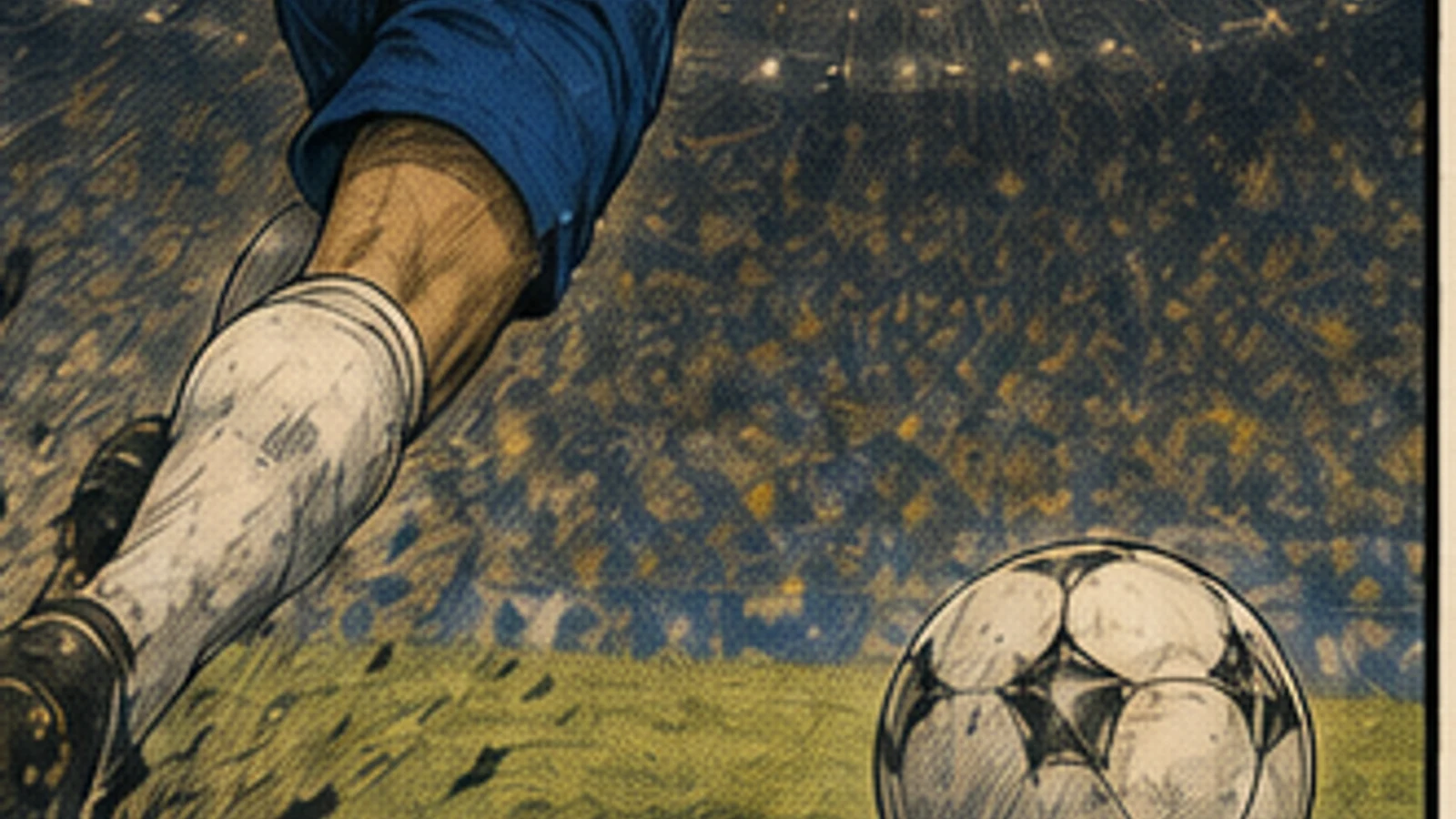
Rivaldo shot from outside the penalty area. Oliver Kahn, the outstanding goalkeeper of the 2002 World Cup, moved behind the ball and failed to hold it.
Ronaldo was already running.
He reached the rebound before Germany’s defenders and finished into the net. Brazil led the World Cup final in Yokohama, and the movement contained the entire story. Ronaldo had anticipated the mistake, accelerated into the penalty area and trusted the knee that had repeatedly betrayed him.
Twelve minutes later, he scored again. Rivaldo allowed Kléberson’s pass to travel through his legs, Ronaldo opened his body and guided the ball beyond Kahn. Brazil won 2–0. Ronaldo finished the tournament with eight goals and the Golden Boot.
Four years earlier, he had entered a World Cup final after suffering a convulsion on the day of the match. Brazil lost 3–0 to France, and the mystery around his selection became inseparable from the defeat. What followed was worse than one traumatic afternoon. Serious knee injuries removed huge sections of his career and created doubt about whether his explosive movement could survive.
The 2002 final did not simply reverse 1998. It completed a recovery that had often appeared physically unreasonable.
The body behind the phenomenon
Ronaldo’s early brilliance depended on a rare combination. He was powerful enough to resist contact, quick enough to escape defenders and technically secure enough to change direction at full speed. The qualities made him look futuristic, but they also placed extraordinary force through his legs.
By his early twenties, Ronaldo had already been named the world’s leading player and become the centre of Brazil’s attack. He starred at Barcelona, then joined Inter Milan. Defenders understood what he wanted to do and still struggled to prevent it.
The 1998 World Cup final changed the public image. Ronaldo had scored four goals in the tournament, but suffered a convulsion hours before facing France. He was initially absent from Brazil’s team sheet, underwent hospital tests and was restored to the starting line-up. He played, but France won comfortably.
The episode created years of speculation, much of it unsupported. Ronaldo later rejected claims that commercial pressure had forced his selection. What could be documented was already disturbing: a young player experienced a medical emergency, returned to the team and performed far below the level expected of him.
The next chapter moved from uncertainty to visible physical damage.
The first rupture
In November 1999, playing for Inter, Ronaldo injured the patellar tendon in his right knee. The tendon connects the kneecap to the shinbone and is central to the force required for running and jumping. For a forward whose game relied on violent acceleration, the injury threatened more than availability. It threatened the mechanics of his identity as a player.
Rehabilitation lasted months. Every stage carried the pressure created by Ronaldo’s fame. A normal return was not enough; supporters and clubs wanted to know whether the phenomenon would return with the same speed.
On 12 April 2000, Ronaldo came on for Inter against Lazio in the Coppa Italia final. It was supposed to be the end of the recovery. Within minutes, he attempted a stepover, planted his right leg and collapsed.
The patellar tendon had ruptured completely.
The scene was frightening because there was little external contact. Ronaldo’s body failed during a movement that had once looked effortless. Teammates and opponents gathered around him as he held his knee. He left the field on a stretcher.
Another operation followed. So did another long rehabilitation. The question was no longer when he would return. It was whether a player built around acceleration could return at all.
Learning to move again
Elite rehabilitation is often described through courage, but courage cannot force damaged tissue to heal. Ronaldo needed surgery, medical care, strength work and time. He also needed to rebuild trust in the leg.
That psychological problem is difficult to measure. A forward makes decisions in fractions of a second. If the mind hesitates before a sprint, turn or tackle, the opportunity disappears. Ronaldo had to perform movements associated with the moment his knee ruptured and believe they would not produce the same result.
He missed Brazil’s qualifying campaign for the 2002 World Cup. The national team struggled and changed coaches. Luiz Felipe Scolari eventually guided Brazil through qualification, then faced a selection decision that appeared reckless to some observers.
Ronaldo had played very little top-level football. FIFA later noted that he returned to Brazil only shortly before Scolari selected the final squad. His appearances for Inter offered limited evidence that he could survive an entire tournament.
Scolari selected him anyway.
The decision carried sporting risk but also recognised something rehabilitation statistics could not show. Ronaldo did not need to reproduce every movement of his younger self to remain decisive. He needed enough speed to enter dangerous areas, enough control to finish and enough confidence to keep moving when defenders expected caution.
The goals returned
Brazil arrived in Korea and Japan without the certainty usually associated with the national team. They had reached the previous two finals, but qualification had been difficult. Rivaldo’s form was questioned. Ronaldinho was still emerging. Ronaldo’s fitness dominated attention.
He answered quickly.
Ronaldo scored against Turkey in Brazil’s opening match, turning in Rivaldo’s cross. He scored against China and twice against Costa Rica. Brazil won all three group games.
The knockout rounds demanded different qualities. Belgium resisted Brazil in the round of 16 before Rivaldo and Ronaldo scored late. Against England in the quarter-final, Rivaldo equalised and Ronaldinho produced the decisive goal from distance. Ronaldo did not score, but Brazil advanced.
Turkey awaited in the semi-final. The match was tense and Brazil struggled to create clear opportunities. Early in the second half, Ronaldo carried the ball across the edge of the area and used the toe of his right boot to send a low finish through the defensive line. It was not the sweeping strike expected from a superstar. It was improvised, efficient and enough to reach the final.
Ronaldo had scored six goals. Germany stood between him and the World Cup.
The final against the tournament’s best goalkeeper
Germany had conceded only one goal before the final. Kahn had driven their run through the knockout rounds and would receive the Golden Ball as the tournament’s best player. Brazil had never faced Germany at a World Cup, despite the countries’ combined history.
The final remained goalless through the first hour. Ronaldo missed an early chance. Kléberson struck the crossbar. Germany threatened from set pieces and Bernd Schneider tested Brazil’s defence.
Then Ronaldo created pressure without touching the ball.
He dispossessed Dietmar Hamann and passed to Rivaldo. Kahn had handled almost everything during the tournament, but Rivaldo’s shot escaped his control. Ronaldo’s run converted a goalkeeper’s rare error into the opening goal in the 67th minute.
The second goal in the 79th minute was cleaner. Kléberson passed inside, Rivaldo stepped over the ball and Ronaldo finished first time. The move was built on timing rather than excess movement. Ronaldo arrived, opened the angle and placed the shot.
When the final whistle sounded, Brazil had won a fifth World Cup. Ronaldo knelt on the pitch, embraced teammates and lifted the trophy that had seemed to move further away with every setback.
A different version of greatness
The Ronaldo of 2002 was not identical to the teenager who had overwhelmed defenders in Spain and Italy. His body had changed. The years of injury altered the volume and type of movement he could produce.
That difference strengthens the achievement.
Recovery is sometimes narrated as restoration: an athlete is injured, works, and returns to exactly what existed before. Ronaldo’s tournament showed another form. He adapted. His movement became more economical. He conserved energy, selected his runs and remained devastating near goal.
He scored eight times in seven matches. According to FIFA’s retrospective, he averaged a goal approximately every 69 minutes. The total was the highest at a World Cup since 1970.
The numbers did not erase the surgeries or guarantee that his knees would never trouble him again. They demonstrated that the injuries had not gained ownership of his career.
The unusual haircut he wore during the final stages became part of the tournament’s visual memory. Ronaldo later explained that it helped move attention away from constant questions about his leg. The distraction worked because the football supplied a better subject.
The run to the rebound
Ronaldo’s two goals in Yokohama are usually remembered as finishes. The first began before Kahn made the mistake.
Rivaldo’s shot might have been held. It might have been pushed away from danger. Ronaldo ran because a forward cannot wait to discover which outcome will occur. The movement required anticipation, but it also required faith in a repaired body.
That is the image that closes the recovery. Not the trophy, the haircut or even the final score. Ronaldo saw the possibility of a loose ball and attacked the space without hesitation.
For years, his right knee had turned ordinary football movements into threats. In the World Cup final, one more sprint turned a mistake into redemption.