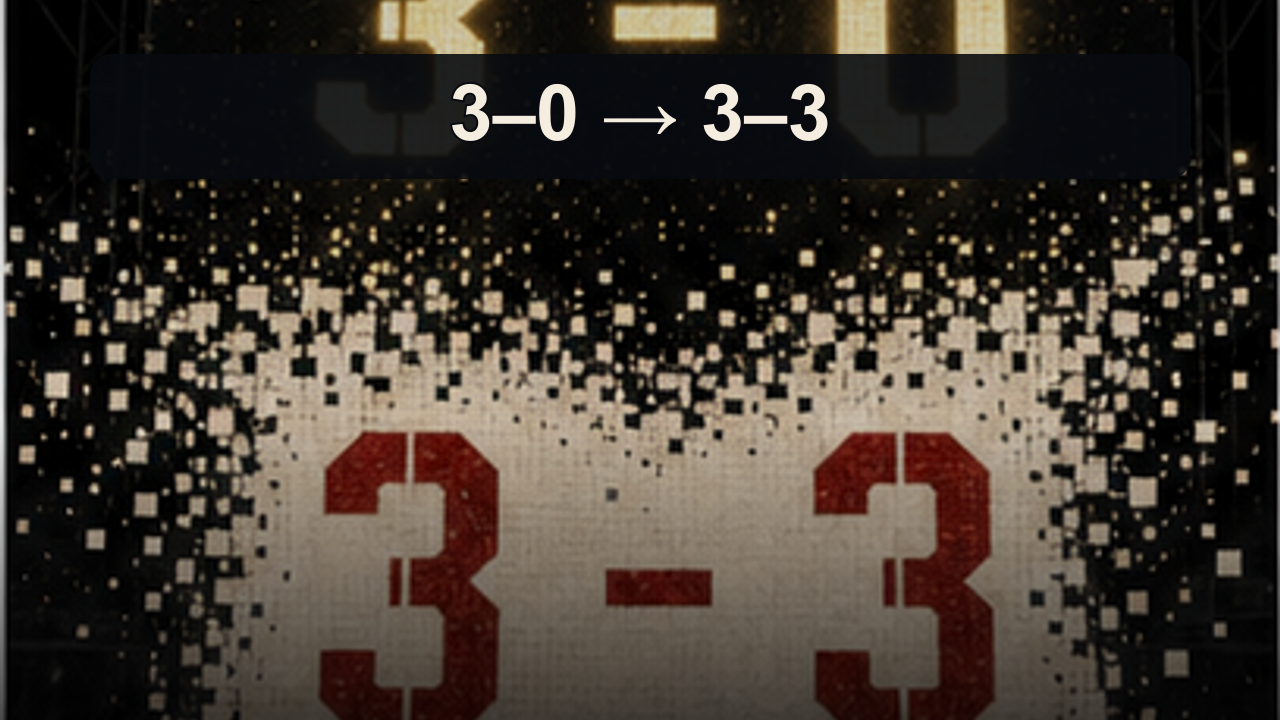
At half-time in Istanbul, Liverpool were not trying to win the Champions League final. First, they had to find a way to make the second half respectable.
AC Milan led three-nil. Paolo Maldini had scored almost immediately. Hernán Crespo had added two more before the break. Milan’s team contained champions in every department and had spent forty-five minutes demonstrating the difference between elite control and Liverpool’s desperate survival.
Some Liverpool supporters were crying. Others sang.
Within fifteen minutes of the restart, the score was three-three.
How did a final that looked finished become the most famous comeback in European football?
The 2005 final is often called a miracle because normal football language struggles to hold everything that happened. But the comeback was not magic. It was created by a tactical change, a captain’s example, a crowd’s refusal to disappear and a sequence of moments in which belief became more useful than logic.
Milan arrived at the Atatürk Olympic Stadium with a side that now reads like a collection of legends. Dida was in goal. Cafu, Alessandro Nesta, Jaap Stam and Maldini formed the defence. Andrea Pirlo, Gennaro Gattuso, Clarence Seedorf and Kaká controlled midfield. Andriy Shevchenko and Crespo led the attack.
Liverpool’s European campaign had been less authoritative. Rafael Benítez was in his first season as manager. His team finished fifth in the Premier League, thirty-seven points behind champions Chelsea. Yet in Europe, Liverpool found a different identity. They escaped the group stage through Steven Gerrard’s late goal against Olympiacos, then eliminated Bayer Leverkusen, Juventus and Chelsea.
The semifinal victory over Chelsea was narrow, tense and controversial. It also made Anfield believe that the club’s European past could become present again. Liverpool had won four European Cups, but none since 1984.
Milan were not interested in nostalgia. They intended to establish control immediately.
Liverpool conceded a free kick inside the opening minute. Pirlo delivered it, Maldini met it and the ball flew past Jerzy Dudek. UEFA records the official time as fifty-two seconds.
The oldest player to score in a Champions League final had produced the fastest goal in one. Liverpool’s plan was damaged before it had properly begun.
They tried to respond. Luis García threatened and Gerrard pushed forward, but Harry Kewell’s early injury forced a change. Milan’s movement remained cleaner. Kaká found spaces behind Liverpool’s midfield and carried the ball with frightening ease.
In the thirty-ninth minute, a sweeping Milan move ended with Crespo scoring from Shevchenko’s cross. Five minutes later, Kaká turned away from Gerrard and split the defence with a perfect pass. Crespo lifted the ball over Dudek.
Three-nil.
The third goal felt conclusive because of its quality. Milan were not simply benefiting from errors. They were playing football Liverpool could not reach.
At half-time, the dressing rooms contained opposite realities. Milan had one hand on the trophy. Liverpool had forty-five minutes to avoid humiliation.
Benítez replaced Steve Finnan with Dietmar Hamann and reorganised Liverpool with three central defenders. Hamann’s presence gave the midfield more protection and helped restrict Kaká. Gerrard gained freedom to move closer to the penalty area.
The tactical change was essential, but tactics needed an emotional spark. Liverpool’s supporters supplied one. Their rendition of You’ll Never Walk Alone travelled around the stadium despite the score.
The players heard a crowd behaving as if the match still mattered. The message was not that Liverpool would definitely come back. It was that surrender had not been accepted.
In the fifty-fourth minute, John Arne Riise crossed from the left. Gerrard rose and directed a header into the far corner. As he ran back, he gestured urgently to the supporters. There was no elaborate celebration. Get the ball. Make noise. Try again.
Two minutes later, Vladimir Smicer struck from distance. Dida reached but could not keep it out.
Three-two.
Milan had gone from complete control to immediate danger. The final changed pace. Liverpool pressed, the crowd roared and every red shirt seemed to arrive a fraction earlier.
In the sixtieth minute, Gerrard ran into the area and was brought down by Gattuso. Xabi Alonso took the penalty. Dida saved it, but Alonso reached the rebound and drove it into the roof of the net.
Three-three.
Liverpool had erased three goals in six minutes.
The speed of the recovery can make the rest of the match feel like an epilogue. It was not. Liverpool still had half an hour of normal time and then extra time against a Milan side full of attacking quality.
The comeback used enormous energy. Liverpool dropped deeper. Jamie Carragher fought through cramp. Milan recovered from the shock and began to create pressure again.
No further goal came in ninety minutes. The final moved into extra time, where Shevchenko received the chance that should have ended the miracle.
Serginho crossed from the left. Shevchenko headed toward goal from close range. Dudek blocked it. The ball returned immediately to Shevchenko, who struck again from only a few yards. Dudek raised an arm and diverted the shot over.
The second save looked impossible even in replay. Shevchenko had scored the winning penalty in the 2003 final. He was one of the best strikers in the world and had been given the ball in front of goal. Dudek’s reaction kept Liverpool alive.
Afterward, the goalkeeper suggested he did not fully know how he had made it. That uncertainty fits the night. By then, events had moved beyond planning.
Penalties placed Dudek at the centre of the story. Before the shootout, Jamie Carragher reminded him of Bruce Grobbelaar’s movements during Liverpool’s 1984 European Cup final victory. Dudek danced and waved on his line, trying to disturb Milan’s takers.
Serginho sent Milan’s first penalty over the bar. Dudek saved from Pirlo. Dietmar Hamann, Djibril Cissé and Smicer scored for Liverpool, while Jon Dahl Tomasson and Kaká kept Milan alive. Riise’s effort was saved, meaning Shevchenko had to score Milan’s fifth kick.
The striker ran forward and hit his penalty down the middle. Dudek blocked it.
Liverpool won the shootout three-two and became European champions for the fifth time.
The Milan players stood in disbelief. They had led for almost the entire match, produced a magnificent first half and created the clearest chance of extra time. Yet the trophy belonged to Liverpool.
It is easy to describe the final as Milan becoming complacent. That explanation is emotionally satisfying and tactically incomplete.
Milan did not stop possessing extraordinary players. They created chances after the comeback and came within a raised Dudek arm of scoring in extra time. Their first half was not erased by laziness; it was challenged by Liverpool’s structural change and a sudden shift in momentum.
Football is unusually sensitive to sequences. One goal can change the choices available to both sides. Gerrard’s header did not merely reduce the deficit. It made Liverpool’s press credible and gave the crowd evidence. Smicer’s strike arrived before Milan could settle. The penalty followed before the match could return to its previous rhythm.
For six minutes, every action confirmed Liverpool’s belief and deepened Milan’s doubt.
That does not mean belief alone wins matches. Liverpool required precise execution: Gerrard’s header, Smicer’s low shot, Alonso following his saved penalty and Dudek’s late interventions. Emotion opened the door; technique carried them through it.
Gerrard became the face of Istanbul because his goal began the comeback and his urgency defined it. His performance also represented the strange relationship between individual leadership and collective momentum.
He could not score three goals alone. He could make one action that persuaded everybody else the match remained alive.
After halftime, his position changed. So did his body language. He attacked the penalty area, demanded energy and defended wherever Liverpool needed him. Later in extra time, he filled in on the right as Milan pressed.
Leadership in that final was not a speech preserved for a documentary. It was a repeated refusal to accept what the scoreboard said was likely.
The supporters mirrored it. Their singing did not cause Milan to miss penalties, but it prevented the stadium from becoming a celebration for the other team. The players and crowd kept passing belief between them until the result changed.
Comebacks happen every season. Istanbul endures because of the scale of the opponent, the stage and the apparent finality of the halftime score.
Liverpool were not chasing three goals against an average defence. They were chasing Maldini, Nesta, Stam and Cafu, protected by a midfield built to control matches. They were not doing it in a league game with future weeks available. They had one half of a European Cup final.
The story also refuses to finish after the equaliser. Dudek’s double save added another impossible escape. The shootout added theatre. Shevchenko, who could have won the game in extra time, became the player whose penalty confirmed defeat.
Every ending created another ending.
For Milan, the pain was severe but not permanent. Two years later, they met Liverpool again in the Champions League final and won two-one. For Liverpool, Istanbul became a foundational modern memory, a night invoked whenever a match appears lost.
The lesson is often reduced to never giving up. That is true but vague. The more useful lesson is that hope needs actions. Benítez changed the structure. Hamann disrupted Milan’s midfield. Gerrard scored and demanded speed. Smicer took his chance. Alonso followed his penalty. Carragher defended through pain. Dudek made the saves.
At half-time, Liverpool’s situation was nearly impossible. By the final whistle, the trophy was theirs.
The night did not prove that every three-goal deficit can be reversed. It proved that probability is not the same as conclusion. Milan had played like champions. Liverpool found six minutes in which the future could be rewritten, then spent the rest of the night protecting what those minutes had created.
Istanbul refused to end because Liverpool refused to accept the first ending they were given.