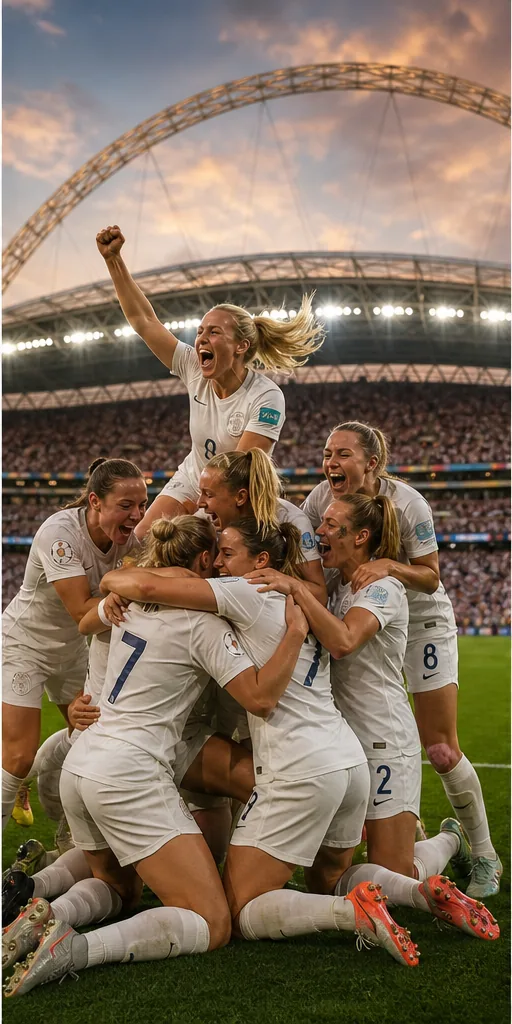
When Chloe Kelly forced the ball over the line in the 110th minute of the Women’s Euro 2022 final, England moved ahead of Germany. The goal also carried decades of frustration, expectation and delayed progress with it.
England had not won a senior major football tournament since the men’s World Cup in 1966. The women’s team had reached European finals before and lost both. Germany arrived at Wembley as eight-time champions, the standard against which every European contender had been measured.
England had home advantage, an unbeaten run under Sarina Wiegman and a tournament that had gathered force with every match. None of that removed the tension of a final.
The force of the tournament had been built step by step. England opened by beating Austria one–nil, a result that settled the hosts without exhausting the emotion of the competition. They then defeated Norway eight–nil, a performance that transformed expectation into genuine belief. A five–nil win over Northern Ireland completed the group stage, but the quarter-final against Spain provided the first moment when the campaign could have ended. England trailed before Ella Toone equalised late and Georgia Stanway struck the extra-time winner. The four–nil semi-final victory over Sweden looked emphatic on the scoreboard, yet it was made possible by surviving early pressure and then taking control.
That route mattered because the final asked England to use every lesson at once. They needed the patience of the opening match, the attacking conviction shown against Norway, the resilience required against Spain and the ability to punish a strong opponent that had defined the semi-final. Tournament football compresses a team’s development into weeks. By Wembley, England had already experienced control, jeopardy and release. Germany would require them to experience all three again in a single evening.
The pressure was sharpened by the opponent. Germany did not represent only another team standing between England and a trophy. Their record in the competition gave them an authority that could be felt before kick-off. England’s task was both immediate and historical: win the match in front of them without becoming trapped by everything the occasion appeared to mean.
Germany suffered a major disruption before kick-off when captain and leading scorer Alexandra Popp was injured in the warm-up. England, by contrast, named the same starting eleven for the sixth consecutive match. Familiarity had become part of Wiegman’s formula, but so had the timing of her substitutions.
The contrast explains Wiegman’s management. Stability was not stubbornness, and substitution was not correction. The starting side established the rhythm, pressed with familiar distances and made opponents work through the opening hour. Then England introduced players with the confidence to change the match rather than merely preserve it. Every substitute knew she was entering a structure that had already been rehearsed. The bench was therefore not separate from the plan. It was one of its defining parts.
That detail is especially important in a final, where caution can make a manager wait too long. Wiegman had created trust before Wembley. Toone and Kelly did not enter as emergency options burdened by the idea that something had gone wrong. They entered as expected participants in the next phase. The difference can be felt in the way Toone attacked the space for the opening goal. She was not playing like someone trying to settle into the occasion. She was playing like someone whose moment had arrived on schedule.
The match remained goalless until the 62nd minute. Ella Toone, introduced from the bench, ran onto Keira Walsh’s pass and lifted the ball over goalkeeper Merle Frohms. It was a finish of extraordinary calm in a contest that had allowed almost none.
Germany responded as champions do. Lina Magull equalised in the 79th minute, converting Tabea Wassmuth’s delivery and forcing extra time. England’s opening had vanished. The final had become a test of whether the hosts could absorb disappointment without allowing it to rewrite the match.
The equaliser changed the sound and emotional temperature of Wembley. For seventeen minutes, England had been protecting a future that suddenly felt close. Magull’s finish removed that certainty and restored Germany’s authority. The danger was not simply conceding another goal. It was allowing the meaning of the equaliser to become larger than the action itself. Germany had levelled the score, but England did not have to accept the old conclusion that Germany would therefore win.
Extra time stripped the contest down. Fatigue reduced the space available for elaborate plans, while every restart acquired greater importance. England’s substitutes supplied fresh movement, but their deeper contribution was emotional. They carried fewer minutes in their legs and no fear of the occasion. The team began to look less like a group waiting for history to judge it and more like a group willing to keep contesting every loose ball until history had no choice.
That was the point at which earlier England teams might have felt history leaning against them. The lead had been close enough to touch, Wembley had begun anticipating the celebration, and Germany had restored the familiar order. Wiegman’s side did not answer by rushing. They continued to compete for territory, trusted the substitutes already introduced and allowed the final to become a contest of endurance.
In the 110th minute, Lauren Hemp’s corner created a scramble. Kelly’s first attempt was blocked, but she stayed with the ball and stabbed it into the net. For a moment she appeared uncertain whether the goal had been given. Then came the celebration: the shirt above her head, teammates chasing, Wembley releasing every second of accumulated tension.
England protected the lead and won 2–1 after extra time. The official attendance was 87,192, a record for a men’s or women’s European Championship finals match. The hosts had won their first major title.
The attendance was not background decoration. It was part of the event’s meaning. Wembley was full for a women’s football final, and the match was treated with the scale usually reserved for the centre of the national sporting calendar. That visibility did not make the players’ work easier. It increased the consequence of every action. They were playing for a trophy while also carrying hopes about what the trophy might unlock.
Kelly’s winner captured that double meaning. At one level, it was gloriously untidy: a corner, a block, a second attempt and the quickest possible touch. At another, it was the precise reward for refusing to disengage when the first chance disappeared. Kelly did not wait to see where the blocked ball would settle. She remained inside the moment. Great finals are often decided by a player who responds before everyone else has finished processing what just happened.
Protecting it required a final transformation. England had spent the tournament showing their attacking range, but the last minutes were about keeping the ball near the corner, winning challenges and denying Germany one final clear route to goal. Kelly’s celebration became the lasting image, yet the composure that followed it was equally important. The team understood that the story was not complete until the whistle confirmed it.
The final worked because it contained the themes that had defined England’s tournament. Wiegman trusted a settled starting side but used her bench decisively. Toone and Kelly, both substitutes, scored the goals. Mary Earps provided assurance in goal. Leah Williamson led a defence that had conceded only once before the final. Beth Mead finished as the tournament’s joint-leading scorer and won the Golden Boot on assists.
Yet the meaning of the victory could not be confined to a tactical plan or a medal ceremony. Women’s Euro 2022 drew a total attendance of 574,875. England’s matches filled major grounds, and the Wembley final produced an image of women’s football occupying the centre of national attention rather than asking for space at its edges.
That visibility created both celebration and responsibility. A breakthrough tournament does not automatically guarantee equal access to pitches, coaching, facilities or opportunity. The strongest legacy would not be that one generation remembered Kelly’s winner. It would be that the next generation found football easier to enter because of it.
This distinction protects the victory from being used as a substitute for progress. Inspiration is real, but it is not infrastructure. A child can watch England lift a trophy and immediately want to play; somebody still has to provide a team, a pitch, a coach and a route into the game. The final created demand, attention and cultural permission. The response to that demand would determine whether the summer became a peak or a foundation.
The players’ achievement also challenged the language traditionally used around women’s sport. The final was not important merely because it might help something else in the future. It was an elite contest with its own tactical tension, physical demands and dramatic resolution. Its wider effect grew from the quality and consequence of the football, not from a request for charitable attention. Recognising that point is essential. Legacy begins by treating the sporting achievement as complete, then asking how its power can be extended.
For young supporters watching in the stadium or at home, the visibility carried its own power. The players were not presented as an alternative version of football’s main event. They were the main event. Names, moments and celebrations entered the country’s shared sporting memory in real time. That cultural shift cannot be measured as neatly as a scoreline, but it explains why the final travelled beyond the usual boundaries of tournament coverage.
The Lionesses themselves understood the distinction. Winning the trophy completed the sporting task. Using the moment to accelerate the game’s growth was the work that followed.
That work requires more than admiration. A packed national stadium can coexist with shortages of local opportunity. A generation can be inspired and still encounter practical barriers when it tries to play. The responsibility belongs not only to the players who produced the moment, but also to the institutions capable of turning attention into access.
The victory also changed the emotional inheritance of the England shirt. Future teams would still carry expectations, but they would no longer be chasing the first breakthrough with every previous disappointment attached. Kelly, Toone, Wiegman and their teammates had given the next England side something different to carry: evidence.
Football “coming home” had often functioned as hope, joke and burden. On 31 July 2022, it became a result. England defeated Germany at Wembley, lifted a major trophy and gave the phrase a new voice.
The lasting value of that summer will be measured not only by the cup England raised, but by how many doors remained open after the celebrations ended.
It will also be measured by memory. Before Wembley, England’s football history contained famous near misses and a men’s triumph receding further into the past. After Wembley, there was a modern image of an England team completing the task under pressure. Toone’s finish, Kelly’s second effort, Williamson lifting the trophy and Wiegman watching the celebration became reference points rather than aspirations.
That matters for future finals. A team can never borrow another generation’s medal, but it can inherit proof that the decisive moment is survivable. The next England side to concede an equaliser in a major match will know the shirt has already been worn by players who recovered. The next substitute entering a final will know two substitutes once supplied the winning goals. Victory changed the questions available to the team.
On that July evening, football came home because England won the match in front of them. The phrase endured because the victory felt shared far beyond the pitch. Its greatest legacy will not be preserved by repeating the slogan. It will be preserved by ensuring that the path from watching to playing, and from playing to belonging, remains open long after Wembley’s lights have dimmed.