THE TWO MINUTES THAT WON MANCHESTER UNITED THE TREBLE
At ninety minutes, Manchester United had almost everything except the one trophy that could complete the impossible.
They were champions of England. They had won the FA Cup. They had travelled to Barcelona for the European Cup final with the chance to become the first English club to win all three in the same season. Yet the stadium clock had reached ninety, Bayern Munich led by one goal, and the red and white ribbons were being prepared for the wrong team.
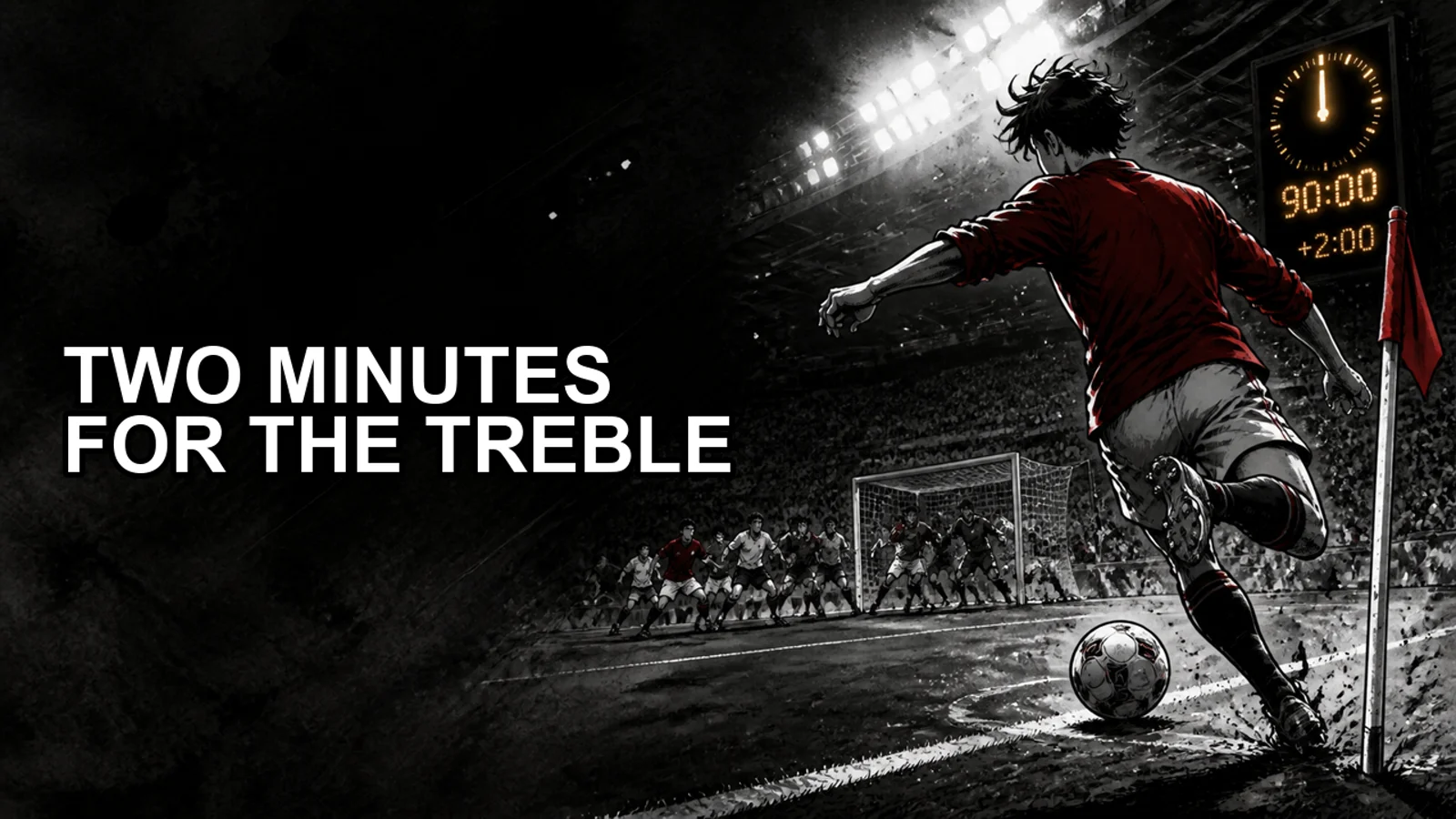
Then David Beckham walked towards a corner flag.
Before the clock could reach ninety-three, two substitutes would turn defeat into victory and a great season into the Treble. The mystery is not only how United found two goals. It is why a team being held at arm's length still had enough belief—and enough finishers—to keep creating a different ending.
The ending was so dramatic that memory can flatten everything before it. But United did not arrive at the Camp Nou through luck alone. Their entire season had trained them to keep playing after the obvious conclusion.
They had survived a demanding Champions League group with Bayern and Barcelona. They had come from behind against Juventus in the semi-final after trailing two-nil in Turin and three-one on aggregate. In England, they had fought Arsenal through a title race and an FA Cup semi-final replay that contained Peter Schmeichel's penalty save and Ryan Giggs's extra-time winner. Again and again, the team had discovered that a match could remain alive after it looked finished.
The final still presented a particular problem. Captain Roy Keane and Paul Scholes were suspended. Keane had driven the comeback in Turin even while knowing a booking meant he would miss Barcelona. Without them, United's central midfield had to be rebuilt. Beckham moved inside. Nicky Butt carried more responsibility. Giggs started on the right rather than his familiar left.
Bayern had no interest in allowing United time to settle. Six minutes into the match, Mario Basler stood over a free-kick just outside the penalty area. His low shot bent around the wall and beat Schmeichel. Bayern were ahead almost before the final had found its rhythm.
That early goal changed the shape of the night. Bayern could protect space and punish United when they chased. United had possession but struggled to turn it into clear chances. Their usual width was altered, their midfield lacked its normal authority, and Bayern looked comfortable controlling the dangerous areas.
Every passing minute strengthened the German side's position. Stefan Effenberg directed traffic. Lothar Matthäus read the game from behind him. Basler threatened whenever Bayern broke forward. United kept trying, but much of their attacking play ended before it reached goalkeeper Oliver Kahn.
Sir Alex Ferguson's answer was not a tactical invention nobody had seen before. It was to place more finishers where a loose ball might fall.
Teddy Sheringham replaced Jesper Blomqvist after sixty-seven minutes. That changed United's shape and gave Dwight Yorke and Andy Cole another forward to combine with. Fourteen minutes later, Solskjær replaced Cole. United now had two substitutes whose careers had taught them how to enter a match already in motion.
Sheringham was intelligent in crowded spaces. Solskjær studied games from the bench, noticing where defenders tired and where rebounds might appear. They were not emergency names pulled from nowhere. They were experienced forwards, introduced because United needed goals immediately.
The risk was obvious. More attackers meant more room for Bayern. Mehmet Scholl clipped the post. Carsten Jancker sent an overhead kick against the crossbar. Either attempt could have closed the final. Bayern were not merely hanging on. They came within centimetres of a second goal.
Those near misses also explain why the comeback should not be retold as a steady rise in United pressure. For long stretches, Bayern had the clearer route to the next goal. Matthäus was withdrawn with ten minutes remaining, a decision later discussed endlessly, but no single substitution can carry the blame for what followed. Bayern still had experienced players on the pitch and opportunities to finish the contest. United's late attack worked because they continued creating disorder, not because the German side suddenly stopped being capable.
The crowd became part of that disorder. United supporters had watched attacks fail for most of the night, yet each late set piece offered a final reason to stand. Players who had spent the match following tactical positions now crowded into the same penalty area. The match was losing its normal shape. That suited the team with nothing left to conserve.
But the second goal did not arrive, and football becomes psychologically strange when a leading team sees the finish line. Every clearance feels like progress. Every lost duel feels larger. The side behind can stop protecting itself because there is nothing left to protect.
As the stadium clock reached ninety, United won a corner. Schmeichel, the goalkeeper and captain for the night, ran into Bayern's penalty area. Beckham delivered. Bayern cleared the first ball, but only as far as Giggs after it was returned into the crowd. Giggs did not strike it cleanly. His attempt travelled across the area rather than towards the corner he intended.
Sheringham adjusted and guided it into the net.
One-one.
For Bayern, the task changed in an instant. A team that had been seconds from lifting the trophy now had to prepare for extra time. For United, survival had created possibility. The players rushed back. There was still time.
From the restart, United attacked again and forced another corner. Beckham walked over to take it. This time the delivery reached Sheringham, who rose and flicked the ball across goal. Solskjær reacted first. He extended his right foot and redirected it high beyond Kahn.
The ball hit the roof of the net.
United had scored twice in added time. UEFA later measured the interval from the corner that started the first goal to Solskjær's decisive touch at one minute and forty-eight seconds. The title speaks of two minutes because football's clock tells the story that way: Sheringham in the ninety-first, Solskjær in the ninety-third. The more exact number makes the reversal even harder to process.
Bayern restarted, but there was no meaningful time to answer. Some of their players collapsed to the grass at the final whistle. Matthäus had already been substituted and watched from the side. United's players ran in every direction, trying to locate one another inside the celebration.
The result was Manchester United two, Bayern Munich one. UEFA later measured the time from Beckham's corner preceding the equaliser to Solskjær's winning touch at one minute and forty-eight seconds. But neither that number nor the score alone explains why the ending still matters.
It completed three trophies in ten days. United had secured the league against Tottenham on 16 May, beaten Newcastle in the FA Cup final on 22 May, and conquered Europe on 26 May. The Treble required consistency across an entire domestic season, survival in knockout football and one final refusal to accept the visible outcome.
It also turned squad depth into the central image of the achievement. The two goals were scored by substitutes. Sheringham had scored in the FA Cup final four days earlier. Solskjær had built a reputation for changing matches late. Ferguson's selections were sometimes described as belief, but belief worked because the bench contained players capable of acting on it.
There is a temptation to say United were destined to win because they had produced late comebacks before. That gives the ending too much certainty. Bayern hit the frame of the goal twice. A slightly different rebound ends the story. Giggs mishit the shot that Sheringham converted. Sheringham's flick for the winner needed Solskjær to move before everyone else. The Treble balanced on actions that could easily have failed.
That fragility is what makes the victory powerful. United's mentality did not guarantee a comeback. It kept enough people moving to make one possible.
Bayern's pain deserves a place in the account. They led for roughly eighty-five minutes and had been the more controlled side for long periods. Their players were not weak because the final escaped them. They experienced the cruelty built into a sport where dominance is never banked until the whistle. Two years later, Bayern returned to the final and beat Valencia on penalties, but Barcelona remained part of their history too.
For United, the final changed reputations. Beckham, who had been vilified after England's 1998 World Cup exit, delivered both decisive corners. Schmeichel ended his United career by lifting the European Cup. Ferguson completed the ambition that had driven his rebuilding of the club. Sheringham and Solskjær became permanently attached to one sequence of play.
And yet the most revealing detail may be what Solskjær expected after Sheringham scored. He thought he was about to play thirty more minutes. That was the rational future: extra time, tired legs, another tactical battle. Instead, he removed that future himself.
The phrase “never give up” is used so often in sport that it can lose meaning. In Barcelona, it was not a slogan. It was a chain of physical decisions. Schmeichel ran forward. Beckham delivered. Giggs chased the clearance. Sheringham adjusted to a poor contact. The team hurried back rather than celebrating for too long. Another attack began. Beckham delivered again. Sheringham won the flick. Solskjær attacked the space.
None of those actions contained the whole comeback. Together, they occupied less than two minutes and completed a season.
That is why the final survives beyond Manchester United. It offers football's simplest warning: the scoreboard describes the present, not the future. At ninety minutes, Bayern were European champions in every sense except the official one. At ninety-three, United held the trophy and the first English Treble.
The ribbons had to be changed. The history books had to be rewritten. And a season built across months was remembered through one minute and forty-eight seconds when Manchester United refused to let the ending arrive on time.