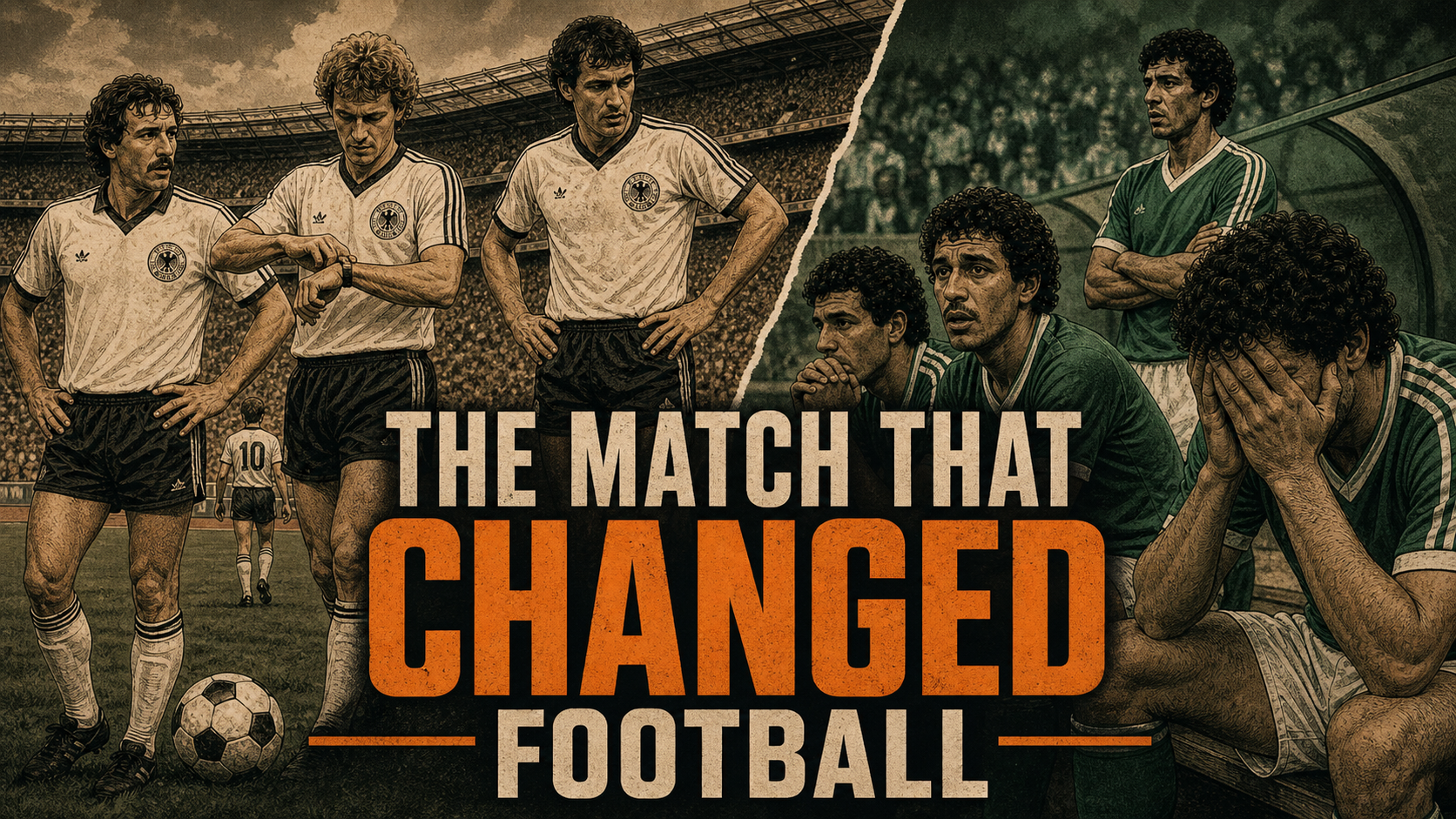
Algeria produced one of the great World Cup shocks, yet a final group match between West Germany and Austria exposed a scheduling flaw that allowed two neighbours to advance together. The outrage in Gijón changed how the tournament was organised.
There are football matches remembered for a goal, a save or a trophy. Then there are matches remembered because the sport looked at what had happened and decided it could never allow the same conditions again.
West Germany against Austria at the 1982 World Cup belongs to the second category. It produced only one goal. There was no spectacular comeback, no disputed penalty and no last-minute winner. The action became less dramatic with every passing minute. That was precisely the problem.
How could a match in which almost nothing happened force the World Cup to change?
To understand why a quiet one-nil result caused such fury, the story has to begin with Algeria.
The outsiders who changed the group
Algeria arrived in Spain for their first World Cup. Their opening opponents were West Germany, the reigning European champions and one of the favourites for the tournament. On paper, the difference in pedigree was enormous. On the pitch in Gijón, it disappeared.
Rabah Madjer gave Algeria the lead in the second half. Karl-Heinz Rummenigge equalised, apparently restoring the expected order. Almost immediately, Lakhdar Belloumi put Algeria back in front. The newcomers won two-one and produced one of the competition’s defining shocks.
It was not a lucky moment stolen at the end. Algeria played with courage, technique and speed. They had demonstrated that the group’s assumed hierarchy could be broken.
Their second match, a two-nil defeat by Austria, complicated the table. Their third restored hope. Algeria beat Chile three-two, completing their group programme with two victories from three games.
But the schedule contained a flaw. Algeria had finished playing before West Germany and Austria met. Both European teams therefore knew the exact score that would send them through.
A West German win by one or two goals would qualify West Germany and Austria. A draw or an Austrian victory would eliminate West Germany. A larger West German win would endanger Austria. The incentives were visible before kick-off: West Germany needed to win, but not by too much; Austria could afford a narrow defeat.
That did not prove the teams had made an illegal agreement. It did mean the tournament had created a situation in which the safest result for both sides was already known.
Ten minutes of football
West Germany attacked at the start. In the tenth minute, Horst Hrubesch scored. At that moment, the scoreline suited both teams.
What followed made the match infamous.
The urgency drained away. Passes went sideways and backwards. Players held their positions. Attacks became rare and risks became unnecessary. The two teams still completed the fixture, but much of the contest no longer looked like a contest in the ordinary sense. The crowd understood the arithmetic and reacted with anger.
Supporters jeered. Reports from the stadium described spectators waving money and accusing the teams of arranging the outcome. Commentators struggled to treat the passing as meaningful competition. In several languages, the match acquired names built around shame and disgrace. The label that endured most widely was the Disgrace of Gijón.
The important distinction is between appearance, incentive and proof. There was no need to invent a secret meeting to explain what viewers saw. Once the early goal arrived, neither side benefited from opening the game. The schedule itself had made caution rational.
That was exactly why the episode was so damaging. A tournament should reward teams for trying to win, not place them in circumstances where two opponents can protect a shared outcome while a third team watches helplessly.
Algeria had done what the competition asked. They had won two matches, including one against a European champion. Yet they were eliminated on goal difference after a match they could no longer influence.
Why it felt bigger than one result
World Cups always contain calculations. Teams protect leads, manage energy and respond to the table. None of that is automatically improper. The problem in Gijón was that advance knowledge changed the nature of the final fixture.
Imagine the same group with its last two matches beginning together. West Germany would still know that victory mattered, but not whether one goal would remain enough. Austria would not know whether Algeria were changing the equation elsewhere. Both sides would have to react to incomplete information. The uncertainty would preserve competitive pressure.
Instead, Algeria’s three-two victory over Chile was already part of the public record. Every player, coach and supporter knew the line between qualification and elimination. Once Hrubesch scored, the teams could reduce danger without guessing what was happening elsewhere.
The scandal therefore revealed something larger than questionable sportsmanship. It revealed a defect in the design of the competition.
West Germany and Austria advanced. West Germany went much further, eventually reaching the final before losing three-one to Italy. Algeria went home, but their impact on the World Cup continued after their elimination.
The rule behind the drama
From the next World Cup onward, the final matches in each group were scheduled to begin simultaneously. That practice is now so familiar that it can feel inevitable. On the final day of a group, television coverage jumps between grounds, live tables change with every goal and teams must make decisions without possessing the finished result from the other match.
The system is not perfect. Information still travels instantly, and late goals can create strange incentives. But simultaneous kick-offs remove the most obvious advantage that existed in 1982: no team should start its decisive final group game already knowing exactly which score will qualify two sides at somebody else’s expense.
The reform did more than protect fairness. It improved the spectacle. Uncertainty is the engine of tournament football. If two matches affect one another, playing them together turns the group into a live drama rather than a solved equation.
Simultaneous kick-offs do not require officials to judge a team’s intentions from the style of its passing. That is an important strength. A governing body may struggle to prove why a player avoided a risky run or why a side accepted a useful scoreline. Scheduling addresses the incentive before that argument begins. It makes the competitors act while the decisive information is still changing, rather than asking investigators to reconstruct motivation afterward.
The solution also protects the team that is not on the same pitch. Algeria’s helplessness was central to the outrage. They had completed their programme and could neither defend their position nor force either European side to take a risk. With both final fixtures underway together, every team retains a route to influence the table while the outcome remains live.
That does not guarantee ninety minutes of constant attack. Tournament teams will still manage scorelines, conserve energy and respond to news from elsewhere. No schedule can remove strategy from football. The reform instead removes the clearest version of advance certainty: two teams beginning a decisive match with the exact completed result that defines a mutually useful margin.
The distinction matters. The lasting lesson of Gijón was not that every cautious pass should become an offence. It was that competition organisers must avoid structures that make caution jointly profitable and leave a rival with no remaining sporting answer.
This is one reason the story matters beyond the teams involved. Many of football’s rules are written in response to a visible failure. A loophole may exist quietly for years until one event demonstrates how powerfully it can shape behaviour. Gijón was that demonstration.
Algeria’s real legacy
It is tempting to tell this story entirely through West Germany and Austria because they played the notorious match. That would repeat part of the injustice. Algeria were not merely the team excluded by somebody else’s result. They were the team whose performances created the crisis.
Their victory over West Germany was a landmark for African football. It challenged assumptions about who belonged among the elite and showed how vulnerable established powers could be against an opponent they underestimated. Algeria finished with four points under the two-points-for-a-win system, the same total as West Germany and Austria. The separating mechanism was goal difference, not a lack of victories.
Their elimination also became a warning to every future tournament organiser. Sporting integrity cannot depend only on asking competitors to behave nobly. The format must make meaningful competition the sensible choice.
That principle reaches far beyond football. Whenever separate events determine a shared outcome, timing matters. Whenever participants know the precise result that benefits both, incentives matter. Good competition design anticipates those pressures rather than pretending they do not exist.
The quiet match that still echoes
There is an irony at the heart of Gijón. The match became unforgettable because so little happened after the goal. Its emptiness gave it power. Every cautious pass made the absent contest more visible.
The anger was not simply that Algeria had been eliminated. Teams leave tournaments through complicated mathematics every year. The anger came from the feeling that the audience had been promised competition and was watching calculation instead.
Football could not erase the result. It could change the conditions that had produced it.
Today, when the final games of a World Cup group kick off at the same time, the arrangement rarely needs explanation. It is treated as part of the natural architecture of the tournament. But it was built from a lesson: fairness is not maintained by tradition alone. It has to be designed into the schedule.
Algeria’s players did not receive a place in the second round. They left something more permanent. Their brilliant upset, their second victory and the spectacle of the final group match forced world football to confront a loophole in plain sight.
The Disgrace of Gijón is remembered as a low point. The response to it became one of the World Cup’s most important safeguards. A match in which almost nothing happened changed what would happen at every tournament that followed.