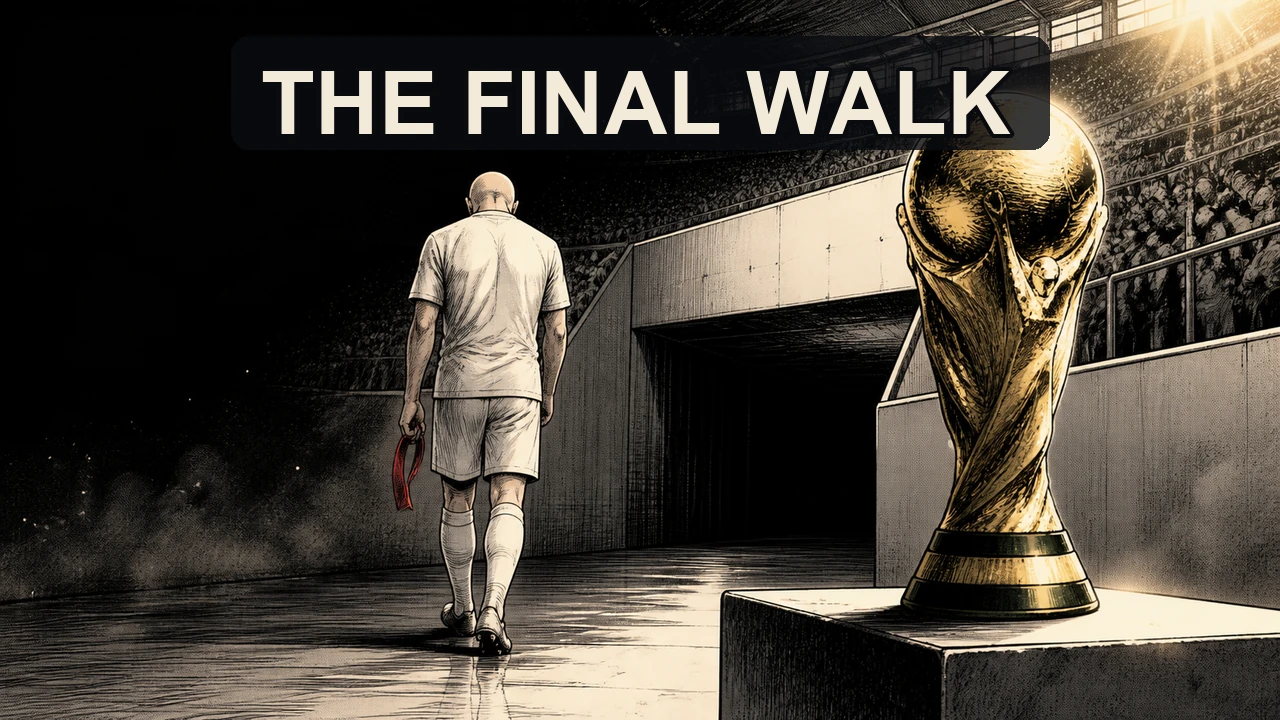
Zinedine Zidane’s final walk as a professional footballer took him past the World Cup trophy.
He did not touch it. He could not. The trophy stood on its pedestal beside the tunnel as Zidane left the pitch after receiving a red card in extra time. France’s captain, the man who had dragged his country toward another final, was gone before the penalty shootout. Italy would lift the cup. Zidane would be remembered for a headbutt.
It remains one of sport’s most powerful images because the ending contradicted everything that appeared to be happening before it. Zidane’s last tournament was becoming a masterpiece. His final match began with audacity. Then, with one violent movement, he rewrote his farewell.
How did one of football’s greatest careers end with its central figure walking past the trophy he could no longer help France win?
A career already complete
Zidane did not need the 2006 World Cup to establish his greatness. He had scored twice when France beat Brazil three-nil in the 1998 final. He had won Euro 2000, the Champions League with Real Madrid and the game’s major individual honours. His control of a football seemed to slow the players around him. He did not dominate through constant speed; he created time where other players could not find it.
By 2006, he was thirty-four and had announced that he would retire after the World Cup. France arrived in Germany with an experienced squad but little certainty. They drew their opening two group games and needed victory over Togo to advance.
Once the knockout rounds began, Zidane changed the tournament. France beat Spain three-one, with Zidane scoring late. Against Brazil in the quarterfinal, he delivered one of his greatest international performances, controlling midfield and creating Thierry Henry’s winning goal from a free kick. In the semifinal against Portugal, he scored the only goal from the penalty spot.
The retirement tour had reached Berlin. One match remained.
The perfect beginning
France won a penalty in the opening minutes of the final after Marco Materazzi challenged Florent Malouda. Zidane stepped forward against Gianluigi Buffon.
Most players choose certainty in a World Cup final. Zidane chose risk. He chipped the ball down the middle. It struck the underside of the crossbar, bounced behind the line and came back into play.
For a fraction of a second, the ball’s path made the stadium wait. Then the goal was confirmed. France led after seven minutes.
It was the kind of penalty that can look foolish if it fails and inevitable if it succeeds. In the final game of his career, Zidane had announced himself with supreme calm.
Italy responded in the nineteenth minute. Andrea Pirlo delivered a corner and Materazzi rose above Patrick Vieira to head the equaliser. The same defender involved in France’s penalty had levelled the final.
The match tightened. Italy struck the crossbar through Luca Toni. France gradually gained influence, but neither side found a second goal in normal time. The World Cup moved into extra time.
The save before the incident
Zidane came close to producing the heroic ending everyone could understand. Willy Sagnol crossed from the right, and Zidane powered a header toward goal. It was hit hard and rising. Buffon reacted brilliantly, pushing the ball over the bar.
Had the header gone in, it might have been the final touch in a perfect international career: captain, match-winner and world champion again.
Instead, minutes later, attention shifted away from the ball.
Zidane and Materazzi exchanged words as they moved upfield. Zidane walked away, then turned. He drove his head into Materazzi’s chest. The Italian defender fell to the ground.
The referee, Horacio Elizondo, had not seen the incident directly. After consulting his officials, he showed Zidane the red card.
There has been endless discussion of the verbal exchange that preceded the headbutt. Zidane and Materazzi later gave accounts, and the specific wording has often been repeated. What is beyond dispute is the sequence visible on the pitch: words were exchanged, Zidane turned, and the headbutt ended his match.
The provocation may explain his anger. It does not make the response permissible. Both ideas can be true at once.
The walk past the trophy
Zidane removed his captain’s armband and began the long walk toward the tunnel. The World Cup trophy was positioned beside his path.
Sports photography depends on moments that contain an entire story. This one did. The trophy represented what Zidane had won in 1998 and what France were still trying to win in Berlin. He passed close enough to see it, but his tournament was over.
There would be no substitution, no return and no club match in which to repair the image. Retirement made the dismissal final in every sense.
France still had to finish the match with ten players. Italy could not score during the remaining minutes, so the final moved to penalties.
The shootout was almost flawless. David Trezeguet’s attempt struck the crossbar and stayed out. Italy converted all five of their penalties, with Fabio Grosso scoring the winner. Italy were world champions for the fourth time.
Zidane was not on the pitch to take a kick. Whether his presence would have changed the shootout cannot be known. Counterfactuals are tempting, particularly because he had already beaten Buffon from the spot. But France’s defeat cannot be reduced to a penalty he never took. Italy held their nerve and completed the job.
Hero and offender in the same match
Public stories prefer clean categories. A player is either the genius or the villain, the leader or the liability. Zidane’s final made that separation impossible.
He had been France’s outstanding figure during the knockout rounds. His penalty in the final was an act of rare composure. His header almost won the match. He was also correctly sent off for violent conduct.
The headbutt did not erase his achievements. His achievements did not excuse the headbutt.
That tension explains why the incident remains culturally powerful. If an ordinary player had done the same thing in an ordinary match, the footage would be remembered as misconduct. Zidane was an artist playing his last game on the largest stage. The fall had a dramatic shape that seemed written, even though no writer would have risked an ending so blunt.
It also challenged the version of Zidane that many casual viewers held. His football looked elegant and controlled, but his career had included previous red cards. Intensity was not separate from his genius. The same pride and competitiveness that powered his greatest performances could also escape its boundaries.
What the camera could not answer
The television replay showed what happened physically. It could not show what Zidane heard, what memories the words touched or why he chose that response at that moment.
This gap allowed the incident to grow beyond sport. The headbutt appeared in songs, advertisements, artwork and political discussion. Some saw it only as disgrace. Others treated it as a refusal to accept humiliation. The image became available for meanings far removed from the match.
But football’s judgment was simpler. Whatever had been said, striking an opponent was a sending-off offence. The referee’s decision removed France’s captain from the game.
The incident is therefore both deeply personal and completely public. Zidane reacted as an individual. He did so in front of hundreds of millions of viewers, while carrying responsibility for ten teammates and a country’s hopes.
Elite sport regularly asks players to perform with emotion while controlling it absolutely. Too little intensity and they appear passive. Too much and they can destroy the performance they were trying to save. Zidane crossed that line in the final minutes of his career.
The farewell that would not become simple
Zidane was awarded the Golden Ball as the tournament’s best player, a vote largely completed before the final. The award added another contradiction. The best player at the World Cup had ended it with a red card.
Italy’s victory deserves its own space. Materazzi scored the equaliser. Buffon made the crucial save from Zidane. Italy’s penalty takers succeeded under the greatest pressure, overcoming a national history of painful World Cup shootouts. Fabio Cannavaro captained a superb defensive team and lifted the trophy.
Yet popular memory often returns first to Zidane. That can feel unfair to the champions, but it reflects the power of unresolved stories. Italy’s ending was complete. Zidane’s was not.
Had he simply lost the shootout, his career would have ended in disappointment but retained a familiar shape. Had his extra-time header beaten Buffon, the farewell would have been almost too perfect. The headbutt created an ending without easy moral comfort.
Zinedine Zidane entered his final match capable of deciding a World Cup with beauty. He left it after an act of anger. Between those moments, he scored, inspired, nearly scored again and then abandoned his team at the point of greatest need.
That does not make the rest of his career meaningless. It makes the final honest about the complexity of sporting icons. Greatness does not remove weakness. Sometimes it places that weakness under the brightest possible light.
The last image was not Zidane holding the trophy. It was Zidane walking past it, close enough to recognise everything he had lost.